South Australia’s election
Outcomes and analysis
The old established parties have much to learn from the South Australian election, but it’s more complicated and more powerful than the simple messages emerging from the media.
There is no shortage of media comment on the surge in support for One Nation, the extraordinary parliamentary outcome for the Malinauskas government, and the contrasting disastrous parliamentary outcome for the Liberal Party.
In my last roundup I predicted that when people came to the ballot box, those who had been telling pollsters that they would vote for One Nation would revert to the Liberal Party, but I was wrong: the final polls were uncanningly accurate. Only in a few polling booths in the old and genteel leafy suburbs – Wattle Park, Unley Park for example – did the Liberal Party vote hold up strongly against One Nation.
There are three clear outcomes that need little qualification, mostly evident on the pie chart below.
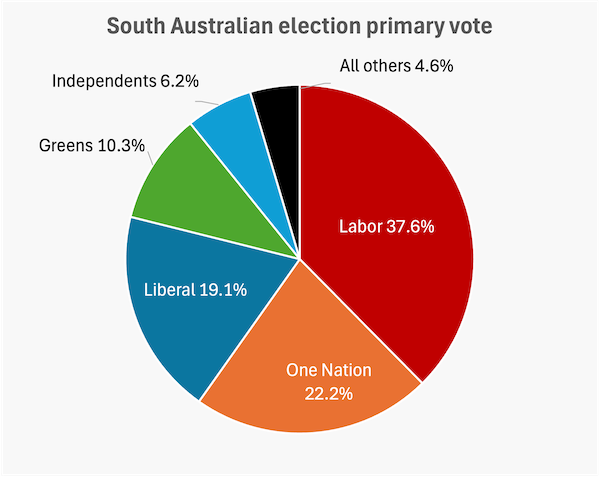
One is that the combined Labor plus Liberal vote was just 56 percent. That’s a new record, ten points below the previous 66 percent record set by Tasmania in 2024.
A second is that this election adds another data point to the Coalition’s losing record: there have been 29 federal, state and territory elections in the last 12 years, and the Coalition primary vote has fallen in 25 of them. This fall, at 17 percent from 2022 compares with the 19 percent fall in the Northern Territory in 2016 and 16 percent in Western Australia in 2017. This trend of falling Coalition primary support was established before One Nation had a significant presence, before Morrison and Dutton ran terrible campaigns, and while Sussan Ley was a relatively unknown backbencher. The Coalition, now running low on scapegoats, might have to start thinking about policy.
The third is that One Nation won 22 percent of the primary vote. That’s about the same as the vote for the Alternative für Deutschland in Germany, lower than the 29 percent vote for the Freiheitliche Partei Österreichs in Austria, and lower than the 50 percent vote for Trump’s Republican Party. A detached observer may simply say that the politics of grievance was just a little slow in coming to Australia.
Antony Green has more comprehensive early observations on the election numbers.
Regional outcomes – the Adelaide conurbation
Media commentators have noticed the different outcomes between Adelaide and what they call the “regions” – a sloppy classification that ignores the geographical complexity of our settlement patterns.
Adelaide itself is too large to be considered as a homogeneous blob: the Adelaide conurbation stretches about 90 km from Gawler in the north to Sellicks Beach in the south. As a first cut this can be divided into three regions:
Northern, the 9 electorates north of Grand Junction Road, once regarded as the city limits. This region includes Elizabeth and surrounding suburbs, settled in the period of postwar European immigration during the days of “White Australia”. The car industry, including the Holden factory and its component suppliers, was a dominant employer in that region.
Central, the 19 electorates surrounding the CBD (including Port Adelaide), which are going through the same transformations as in other capital cities, although more slowly. There is densification in and around the CBD and around Glenelg. Some of the older working-class suburbs are yuppifying.
Southern, the 5 electorates south of Flinders University, stretching along the southern freeway. Like the northern region this has been settled by migrants, but in later waves as the White Australia policy faded. It has also been subject to de-industrialization, but not as drastically as in the north. And because it’s in a narrowing strip close to some of the state’s best beaches, it is a much more pleasant area to live than the northern suburbs, which are on a wide plain and without anything that could be called a beach for recreational purposes.
Although in all three Adelaide regions the Labor primary vote was about the same, there were significant differences in votes for other parties. In both the northern and southern regions the Liberal vote was low (in single digits). In the northern region the One Nation vote was particularly strong, but it was significantly weaker in the southern region.
In the central region the Liberals easily outpolled One Nation, and unsurprisingly the Green vote was comparatively strong. In this region the contest has been closer to a traditional Labor-Liberal one, spiced up with some impressive performances by the Greens.
It is notable that there have been no teal independents in the contest for Adelaide seats. This is the political territory slowly being colonized by independents in other states. In Adelaide that ground has nurtured centrist gatherings such as the Liberal Movement and Centre Alliance (Nick Xenophon) in the past, rather than independents. For now Adelaide people seem to be reasonably satisfied with a conservative and administratively competent Labor government. For now the Liberal Party is already largely pushed out of Adelaide and there is no need for teal independents to achieve that result.
In both the northern and southern regions Labor’s vote fell from its 2022 election level, but that was from a high base, while in the central region it held up, although that was with some offsetting swings in particular electorates.
The urban regional classification I have used is broadly similar to one Casey Briggs generated in his informative postabout One Nation’s rise, fall, and resurrection. His map shows the party that has most primary votes, excluding Labor. In the north and the south, and a good way into the centre, that party is One Nation. Only in the prosperous southeastern suburbs, and the seaside suburbs, have the Liberals held that position.
Interpretating the Adelaide vote
It would be rash to over-interpret these Adelaide results for their wider implications.
These Adelaide results, however, are generally consistent with the observation that throughout Australia previous outer-suburban Labor strongholds have been drifting to the Coalition over many years. In this election voters have taken a further step, abandoning the Coalition and moving en-masse to One Nation. This move has been strongest in the older de-industrialized suburbs.
In the Adelaide conurbation at least Labor seems to be sitting comfortably for now. Even though it has been losing support in the northern and southern regions, the Labor plus Green vote is still well ahead of the Liberal plus One Nation vote in all three regions, but unless there is a significant shift in voter sentiment, in time Labor will lose those outer-suburban seats.
To what extent is the move to One Nation an attraction to its policies, an angry message to a disgracefully incompetent opposition, or maybe a fear that South Australia is becoming a one-party state?
One Nation’s policies, sparse as they are, may appeal to some. (Kurt Sengul of Macquarie University and Jordan McSwiney have a Conversation post What does One Nation actually believe in?, painting a picture of hollow statements, economic naivety, confusion, and contradictory policies.) Because Adelaide’s house prices have risen so strongly the idea that they are pushed up by immigration has a superficial logic. Few people stop to think of migrants’ contribution to the labour force. Unfortunately, the party’s racism has appeal to some. Anyone older than 70 would have grown up in or migrated to a “White Australia”. To those who take only a superficial interest in politics – and that’s a large proportion of the population – One Nation might come across as something new and energetic with some ideas on housing and the cost of living: it’s worth giving them a go.
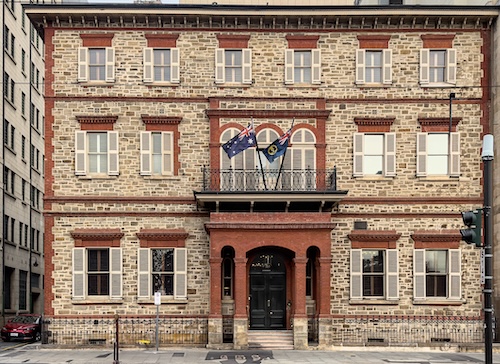
Adelaide Club — Hanson and other women not welcome here
Those who have had a long-term attraction to the Liberal Party would surely be feeling deeply annoyed by the party’s performance in opposition, federally and in South Australia. They would not understand why it has turned away from the centrist approach of the comparatively popular Marshall government (the last Liberal government in South Australia), to right-wing political opportunism. South Australia has a long tradition of political liberalism that has delivered centrist governments. The once-loyal Liberal voters of Medindie, Springfield and Tusmore aren’t going to turn to Labor or the Greens – that would be too much. But for some of the more daring of them a protest vote for One Nation, even though Hanson and Joyce would not be welcome at their soirees, is a politically low-cost way of telling the Liberal Party to grow up.
And then there are voters who don’t like the idea of South Australia becoming a one- party state. Before the election Labor held 30 of the 47 seats in the Legislative Assembly. Now it is headed to 34 seats by the latest counts.
The irony is that voters’ dissatisfaction with the opposition and fear of Labor dominance has delivered a smaller opposition, less competent in public policy, and even more divided.
It is also strange that voters have turned to a party similar to Trump’s MAGA Republicans, as the dangerous idiocy of their policies is coming into full display, both in the USA and in the world at large. A grievance party that gains political power in a democracy fails because it has no notion of using power in the public interest. Think of a dog that succeeds in catching a car and finds itself in the driver’s seat.
The rest of South Australia
Then there is the rest of South Australia, comprising 14 electorates. To use the adjective “regional” as a single descriptor misses the point that it’s a 16-hour drive from Marla to Mount Gambier, and that the settlement patterns and geography within South Australia (as in other states) are as different as between Iraq and Italy.
In the Heysen electorate in the Adelaide Hills the Green vote is above 20 percent, outpolling One Nation, while in the Narungga electorate, in the Yorke Peninsula wheat belt, the Greens are polling around 3 percent. In most of these 14 electorates Labor’s primary support is below 24 percent, but in the Giles electorate which takes in Whyalla, it is around 50 percent. In the huge northern Stuart electorate an independent will probably hold his seat on the basis of strong support in Port Pirie, but in some booths in the same electorate the One Nation vote is well above 35 percent. In the McKillop electorate in the southeast, a mixture of small farms originally allocated to soldier settlers, vineyards, and prosperous stud farms, the One Nation vote is above 35 percent – touching 50 percent in some places.
The only safe generalization one can make about these 14 diverse electorates is that One Nation is exploiting the politics of grievance. The agricultural regions were prosperous places by the standards of Australia in the postwar years. A medium-sized farm could provide a family with a comfortable lifestyle. The railroads provided a solid employment base in many places, and a base for the Labor Party. These electorates were once contestable between the main parties. (We might recall that the Labor Party celebrates its 1891 origin in the great shearers’ strike.)
Over the long term, however, while real living standards in the cities have risen three or four times, farming incomes haven’t – apart from the cases where there has been consolidation of holdings and the rise of agribusiness. Climate change, and rising fuel costs, are adding to farmers’ difficulties. Many railroads have been closed and those that remain employ few people. Over many years people have reasonably been asking for better roads, but when they have been provided they contribute to the collapse of small communities and the consolidation of services, including in the capital city.
In the corridors of political power there is an attitude that these places are bloody nuisances. Public servants in state and federal treasury departments see them as financial liabilities – their tax base (income tax and GST) is low, and there is a high cost of providing lightly trafficked roads, small schools and hospitals, and police services serving large areas. That’s the fiscal perspective. The electoral arithmetic of rural Australia is such that politicians of both the old parties believe they can safely ignore it, because until last Saturday night, most rural seats were considered safe for the Coalition (the Liberals in South Australia).
In some regions that already have a well-defined community this is giving an opportunity for independents to gain enough support to be elected. In South Australia 3 or 4 independents will be elected or re-elected, all in non-metropolitan electorates, and on issues that overlap with, but are separate from the issues that have seen independents elected in capital cities. They may have been helped by One Nation’s decision to place independents ahead of Labor and the Greens on some how-to-vote cards.
In the Farrer federal electorate, due to go to the polls on May 9 in a by-election precipitated by Sussan Ley’s resignation, the independent candidate Michelle Milthorpe has a good chance of winning. If, as is possible, the government increases the number of federal electorates, each would become smaller, making it easier for independents to represent better-defined non-metropolitan regions.
Otherwise One Nation is moving into that space. For many years Coalition politicians have been preparing that space for One Nation, with their explicit policies on climate change, and their dog-whistling hints about re-establishing White Australia. When all the South Australian counting is over, it is probable that the Coalition’s decision to put One Nation ahead of Labor in its how-to-vote cards has cost it seats. (In Germany and Austria centrist parties generally relegate communists, fascists and other extreme right-wing parties to the political fringes.)
The National Party, having found support among the mining oligarchy, long ago lost its attachment to rural Australia. One Nation too is supported by the mining oligarchy, which helps explain their policy on climate change, but its cultivated public face is one of people who talk in plain language, offering simple solutions to complicated problems.
Labor has the excuse that its working-class base of railroad workers, drivers, shearers, casual labourers and station hands has largely disappeared, but that’s a weak excuse, as if there is no way to represent the interests of the disadvantaged except through the union movement.
The state-wide inequality gradient
That brings us back to the more general geography of the South Australian election. With some exceptions, such as pockets of prosperity in the Adelaide Hills, the further one moves from Victoria Square, the poorer are the electors – in terms of both income and wealth. They are signalling those grievances at the ballot box. It’s a geographic manifestation of the inequality that we have been allowing to grow over the last fifty years.
Rather than talking about worsening inequality, however, our political commentariat has been talking about a “cost of living crisis”. That’s rubbish: most Australians can count themselves as among the world’s economically privileged. But many have been left behind.
Labor’s approach to inequality is incremental: it doesn’t want to scare the horses with bold distributive policies. It will probably see that approach vindicated by its extraordinary success, in terms of representation, in South Australia, replicating its success at the Commonwealth level.
The Coalition’s approach has been to ignore inequality, and in Trumpian fashion to promote policies that would make inequality worse. Its “small government” platform could not be implemented without deep cuts in the social wage – particularly health care and education – and further deterioration of the capacity of government to play its part in contributing to economic prosperity. Unable to contribute a realistic policy platform of its own, it defines its raison d’etre as keeping Labor out of office because, in ways it never specifies, it says a Labor government is a terrible government and that Australia is on the wrong track. To the Coalition politics is a combat sport, the aim of which is destruction of the enemy, rather than a competition in offering good policy in the public interest.
This approach legitimizes the politics of grievance, to the advantage of One Nation, which does grievance and lies about climate change and immigration even better than the Coalition.
Voting systems
Finally, and not just for fun, I considered how this election may have turned out under different voting systems – preferential (the system we actually use), first past the post, and proportional representation (as used in Tasmania and the ACT). Seats are based on the count so far.
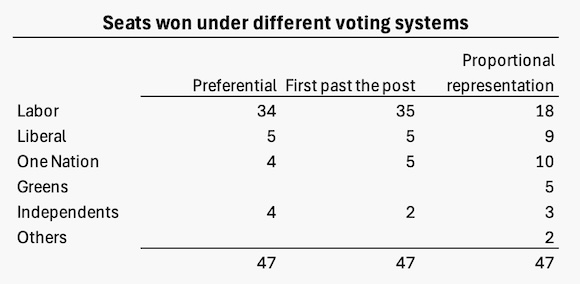
It is surprising to find, in this election, how close are the outcomes in preferential and first-past-the post systems. Under proportional representation Labor would be the biggest party, but would have to form an agreement with the Liberals, or with the Greens and at least one independent or minor party member to govern. That sort of outcome is quite common in mainland European democracies.
Data for this post is from the Poll Bludger guide to the election and the ABC guide to the election. Both draw on the Australian Electoral Commission.
How political commentators see the South Australian election
The media focus is largely on implications for the Coalition, particularly the Liberal Party.
Much of the commentary on South Australia’s election draws comparison between the South Australian situation – a state election where the Liberal Party runs on its own without the burden of the National Party – and the federal situation.
On Monday night’s Late Night Live SBS political correspondent Anna Henderson reminded us of the Liberal Party’s particular troubles in South Australia, including the former party leader having been convicted of distributing cocaine. (He won 14 percent of the vote in his electorate, while the endorsed Liberal who replaced him won only 9 percent.) But the state branch shares with the federal Liberal Party the problem of factional left-right conflicts, and the so-called “moderates” have largely been driven out of the party’s parliamentary and organizational ranks, as South Australian ABC journalists Thomas Kelsall and Eugene Bolsvert report on the ABC website.
Writing in The Conversation, Rob Manwaring of Flinders University describes the tensions within the South Australian party, between those who want to be more centrist, and those who believe its policies are and should remain closely aligned with those of One Nation. This is the same conflict that is being played out federally, with the complicating factor of a National Party in the federal coalition.
Crispin Hull on his post focuses on the policies that have turned people away from the Coalition, and that have left people disappointed with Labor: Gutful. Fed up. What to do about it. He writes about a reaction to the Liberals’ “small government” ideology, and Labor’s extreme political risk aversion. The Liberal Party has become “a party of opposition to everything Labor does or wants to do, he writes. Voters are dissatisfied:
Voters now want government to fix things; to do things; to get involved in helping people with health, education, housing and the cost of living; and to stopping big, rich corporations and individuals exploiting people to gain even more wealth that they do not need. Voters have witnessed declining government services and growing inequality as the top end of the private sector grabs most of the wealth, evades and avoids taxes, and rips off consumers. That is the inevitable consequence of downsizing, out-sourcing and deregulation.
And Labor has become complacent and inattentive to the public’s needs:
Federal Labor’s non-response to more than 150 parliamentary committees’ reports over the past four years is a case in point. Oodles of time, thought, and experience has been given by experts and ordinary players into suggesting how to fix whatever was being looked at: gambling, food labelling, vehicle standards, tax, algae in the rivers, air quality, financial abuse of the elderly. The list goes on and on.
Hull also issues a warning, so far overlooked by most of the commentariat, that on South Australian numbers and some national opinion polls (e.g. the latest YouGov poll), One Nation could be headed for six or more federal Senate seats in 2028. The consequences for our country, whoever wins a House of Representatives majority, could be disastrous.
Otherwise the general view of the commentariat is that the Liberal and National Parties have to determine a place for themselves somewhere along a left-right spectrum. Although there have been times, particularly during the Howard government, when the Coalition parties have distanced themselves from One Nation, the general pattern has been for the Coalition parties to make preference deals to put One Nation ahead of Labor, and to take on some of its populist policies, including economically destructive policies such as opposing the transformation to renewable energy.
By contrast, on the left, even when the Communist Party support was strong in the postwar years, the Labor Party didn’t go along with the idea of some “left” coalition, always keeping its distance from the CPA and emphasizing the difference between social democracy and communism
Twice in the last year, when the Liberal-National coalition ruptured, Sussan Ley and others had a chance to make the separation permanent, but didn’t take it. A detached observer of the Australian political landscape, seeing the outcome of the South Australian election as yet another episode in the death of the Coalition, would believe that some new centre-right party could emerge before the next federal election.
There are some suggestions that the independents could form themselves into a party, encouraged to do so by donation laws that privilege parties over independents. Mike Seccombe canvasses this opportunity in his Saturday Paper article Why the independents may be forced into an alliance. He acknowledges the logical contradiction in the idea of a party of independents, but with the application of a little Jesuitical reasoning there could emerge a party united around the idea of local representation, and perhaps the radical idea of political integrity.