From the Strait of Hormuz to Australia
Coping in a world of weaponized energy
The disruption to oil supply has taken us by surprise. It was predictable, however, even if we couldn’t be sure how it would be manifest.
In November last year no one was talking about the re-emergence of a 1973-style oil supply crisis.
Well, almost no one, because Dan Kurtz Phelan, Editor of Foreign Affairs, has brought to our attention an article in last November’s edition The return of the energy weapon: an old tool creating new dangers, by Jason Bordoff and Meghan O’Sullivan, both of whom are well-informed on energy and foreign relations.
They didn’t foresee the precise developments that would lead to closure of the Strait of Hormuz and the blocking of a fifth of the world’s oil supply. Trump’s bellicose approach to foreign policy has taken everybody by surprise. But they did predict that “at a time of renewed great-power competition and economic fragmentation, energy has once again become an attractive instrument of geoeconomic coercion”, just as it has in times past.
The world has become somewhat complacent, they warn. But once again the world supply of oil is becoming more concentrated, and demand is still rising, putting more market power into fewer hands, including Russia’s hands. Also the comparatively liberal global trading order has given way to trade intervention, exemplified by Trump’s weaponization of trade.
Bordoff and Sullivan see the transition to renewable energy as the most important defence countries can and should take, but they also warn about China’s dominance of the supply of key minerals – graphite, rare earths, cobalt and lithium – that are needed for this transition. In a world of clean energy China could become what Saudi Arabia was in 1973 when the world was much more oil dependent.
They don’t mention Australia, but the medium and long-term policy implications are clear: we need to be accelerating our clean energy transition and building our capacity to mine and process key minerals.
That message is taken up by a group of defence security experts and retired senior defence force officers, who see our concerns about fuel security as a wake-up call. It would be hard to find a group with more solid conservative credentials. The title of their open letter in Australian media, under the authorship of “The Australian security leaders climate group” – Oil wars threaten our security – takes the issue beyond the Coalition’s partisan conflicts on renewable energy, and beyond concerns about pump prices for gasoline and diesel fuel. It’s about national security in all its dimensions. Their letter concludes:
We call on the Australian Government to accelerate the transition to clean, domestic energy. Rapidly expanding renewable energy — including wind, solar, batteries, hydro and renewable fuels produced in Australia — and electrifying our transport system with home-grown energy will strengthen Australia’s security, reduce exposure to global energy shocks and help limit the escalating risks driven by climate change.
That’s at a fairly high level of generalization. On a Radio National interview with Fran Kelly, John Blackburn, former deputy chief of the Air Force and one of the group, talks about immediate and longer-term practical issues in energy security: Our bowser panic masks a bigger conversation to be had about where we source our energy.
He goes into the details of energy security. For example we tend to think of oil as a simple fungible commodity, but different sources have different properties, which is why we are still exporting some oil and condensate, while we try to secure our sources for imported products. We become concerned about gasoline and diesel fuel, but we also need kerosene for civilian and military aircraft. For the foreseeable future we will need special fuels and lubricants, which is why even if we reach net zero by 2050 we will still be burning some fossil fuels.
It appears that in the very short term we are over-reacting to the disruption to liquid fuel supplies. In fact the same Radio National session starts with an executive in a service station chain calling on people to stop panic buying: the government has the situation under control, but panic buying itself sets up a feedback loop that causes shortages. “I absolutely endorse everything Chris Bowen says” he says. In a post with the unnecessarily alarming title Australia has never been more vulnerable to an energy crisis Ian Verrender explains how our oil and liquid supply chains work: there’s nothing to worry about, for now – apart from higher prices.
In this context there is a great deal of confusion and misinformation about our reserves. People who still haven’t exhausted their Covid-era stocks of toilet paper are now out there panic buying gasoline. When they hear that Australia has 36 days of gasoline reserves, some seem to interpret that as a forecast that the servo pumps will run dry on 27 May. (An opportunity to get some jerrycans from Bunnings, fill them up now at $2/litre, and sell them to the highest bidder on 28 May.) But the more reasonable assumption is that we will still be getting 80 percent of our normal oil supplies. Even if there is no behavioural change, we still have about five months of reasonably assured supply.
But in the longer term, in expecting that some day soon the Strait of Hormuz will re-open and life will be back to normal, we may be too complacent, as Verrender explains in another post Why financial markets have thrown logic to the wind. Echoing the warnings from Bordoff and Sullivan, he warns that the disruptions to the global economic order resulting from the present energy conflict will be far more impactful than inconvenience for vehicle operators.
Whinging Australians
Australians should stop whinging about gasoline prices. They don’t know how underpriced it is by world standards.
When I come across people at servos in a Ford Ranger or a Toyota Hilux complaining about gasoline prices, and when I see them on our roads accelerating and braking aggressively, as if there is something smart about wasting fuel, I update and re-present this chart of gasoline prices in other countries.
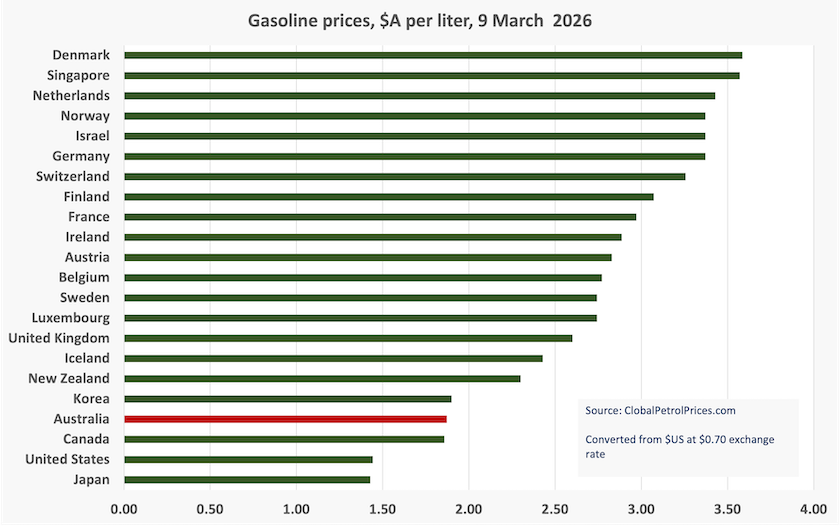
If our government were to double our fuel excise, bringing it up from 46 to 92 cents a liter, our pump price would be about the same as in the UK. That would finance better roads, contribute to a balanced budget, achieve faster progress to net zero, make us less dependent on fossil fuels produced in politically unstable regions, and would see the removal of those monstrous utes from our roads. If people want to be identified as deniers of climate change they can buy a MAGA cap on E-Bay: it’s cheaper than a Ford Raptor and costs nothing to run.