Politics
South Australia’s election
In the roundup of March 7 I incorrectly wrote that the election was on March 14. That was the day when polling opened. It is actually today, as the media have been reminding us.
The South Australian election will be closely watched because it involves a contest between the Liberals and One Nation.
A (highly speculative) election guide
On Saturday night the politically addicted will be tuning into Casey Briggs’ election guide on the ABC. They will find William Bowe’s state election guide on Poll Bludger a rich resource of information.
The table below shows the results of the 2022 state election for the House of Assembly. Note that in South Australia there is no Coalition: the Liberal Party stands in its own right. Five candidates are standing under a “Nationals” banner, but they have no formal connection with the Liberal Party.
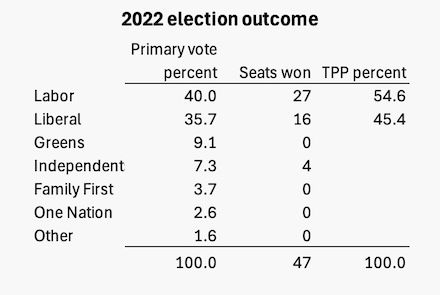
That table overstates the Liberals’ starting position in the House of Assembly by three seats, because since 2022 it has lost two by-elections to Labor and a sitting member has resigned from the party to run as an independent.
Over the last month there have been three state polls, all pointing to a strong Labor primary vote and a strong Labor TPP outcome over the Liberals or over One Nation. These are shown in the table below.
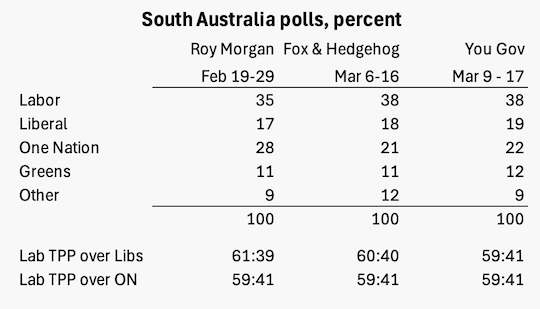
It is notable that over the few weeks since the February Morgan poll, support for One Nation has fallen, and seems to have gone back to Labor and the Liberals. Maybe this is because voters use early polls simply to register a costless protest against the parties but get more serious as the election approaches. Maybe it is because as people look at what One Nation promises, they find nothing that will alleviate their grievances. Or maybe the movement is simply a sampling error.
Pundits are speculating on outcomes involving an even larger majority for Labor in the Assembly than its present 29:13 majority, and a vanishingly small number of seats for the Liberals. Fox & Hedgehog finds that support for One Nation rises and support for Labor falls as one moves from Adelaide CBD to the outback. It suggests that One Nation’s “strongest prospects” are in 5 rural electorates, but its specific seat polling would be based on very small samples.
While most media attention is on seats in the Assembly, there is also a contest in the Legislative Council, where Labor does not presently have a majority, but they could have one after the election. One Nation politicians are predicting that they may have some success in the Legislative Council, particularly with their high-profile candidate Cory Bernardi. (They won one Legislative Council seat in 2022, but as has often been the case in other parliaments, the member subsequently resigned from One Nation.) Casey Briggs has a post about the possible outcomes in the Legislative Council.
Writing in The Conversation – South Australian election is likely to be Labor in a landslide. But who will be the opposition? – Clement Macintyre of Adelaide University describes South Australia’s political landscape in some detail. If South Australia were more like New South Wales or Victoria, One Nation would have a good chance of picking up a rural seat or two. But in South Australia there aren’t many rural seats (78 percent of South Australians live in Adelaide), and some of those seats have strong new or re-contesting independents.
My own speculation is that the Liberals will lose significant support both in terms of votes and seats, but should do better than the 17 percent in the Morgan poll. In part that’s because prediction of a landslide favouring the government prompts some voters to switch to the opposition. I am more confident that this will continue the Coalition’s losing streak over the last twelve years. There have been 28 state and Commonwealth elections held since 2014: the Coalition’s primary support has fallen in 24 of them. South Australia’s outcome will almost certainly make it 25 out of 29.
I mention this, as I have in post-election roundups, to stress the point that the Coalition’s troubles didn’t start with Scott Morrison, Peter Dutton or Sussan Ley, and they haven’t been confined to the federal party. Their troubles have been brewing for a long time, but until the last few months few in the media have noticed. Labor’s performance hasn’t been too flash, but it has certainly done better than the Coalition.
Regarding the question about who forms an opposition, implicit in the title of Macintyre’s Conversation contribution, the most likely outcome is that there will be a small core of Liberal MPs, some having been saved by preferences flowing from Labor in marginal electorates. But it is possible that sitting opposite the government benches there will be a mixture of One Nation, Liberal and independent members. If so, appropriate protocols will need to be developed. It is crucial for a democracy’s health that a government with a large majority be kept in check, but that doesn’t necessarily have to be a specific “opposition”, headed by an “opposition leader”. These are simply conventions borrowed from the parliament of one of Europe’s offshore islands. South Australia has a strong history of democratic innovation (first with women’s suffrage); it can surely work out something for the post two-party era.
How-to-vote cards
William Bowe on his Poll Bludger site reminds us that parties’ how-to-vote cards are more relevant in South Australian elections than they are in other elections, because in that state they are displayed in polling booths. Notably the Liberal Party cards put One Nation ahead of Labor and of competitive independents. This seems to result from an alignment of values between South Australian Liberals, or from a visceral hatred of Labor, because there has been no formal preference deal with One Nation.
Working class consciousness for our times
Progressives and the left should re-develop the forms of working-class consciousness that supported social-democratic parties in the twentieth century.
A common political narrative is that the traditional social-democratic parties – Labour, Social-Democratic, Democrat, Socialist, Labor (pick your name) – have become detached from their working-class roots and have been taken over by educated and progressive elites, such as academics and other professionals – the “Brahmin left”. The working class of today, including those in precarious employment, feeling betrayed by traditional social-democratic parties have drifted to political movements on the right, particularly the populist right. These movements are attractive to the working classes because they recognize workers’ grievances around inequality and living standards, even while their policies are likely to support the already privileged classes.
This is the theme of a Substack essay by well-respected political analyst Kos Samaris: The death of the Brahmin left – the Vegemite version in Victoria – in which he looks at the drift away from Labor in outer-suburban Melbourne electorates. That drift in support is masked by electoral outcomes that have gotten Labor over the line, but their winning margins are shrinking. He sees this as a local version of political developments in the UK and the US that emerged ten years ago, particularly around Brexit and support for Trump. These developments have been slower to take hold in Australia because of our more democratic voting systems (compulsory voting, preferential voting).
But these political trends are underway in Australia, and it is up to the parties on the left to “reconstruct a politics and a practice relevant to the twenty-first century, or [decide] whether they will continue refining the Brahmin project for an educated minority while the communities they once represented find their political expression elsewhere”.
Other political commentators are guardedly making the same predictions. But Ian Dunlop has a Substack article – Re-scoring the progressive songbook – in which he respects Samaris’s analytical insights, while questioning the idea that the challenge for the progressive left is to adapt to currently-held political views of the working class. These views have been formed by a lack of political consciousness, by poor journalism, by campaigns of misinformation and by cynical exploitation of people’s grievances. He suggests that “the politics we need is one where the working class acts for itself, in its own interests”.
That’s about re-building the institutions and practices, formal and informal, that once gave the working class not only political power, but political power that promotes its interests. For the progressive left he suggests:
… that implies a shift from targeting to organising, from research to institution‑building, from segmentation to solidarity. It implies unions that are once again schools of politics, not just service providers; tenants’ organisations that can credibly threaten landlords; local party branches whose decisions cannot be overridden by factional deals; workplace committees that can link cost‑of‑living campaigns to industrial power.
It’s not a radical idea, but it’s a challenge for political parties on the left, whose task would become the hard slog of re-building local communities of interest, and of helping people understand politics and the economy. That takes a different skill set, and a different mix of resources, from researching and developing policies to be rolled out at election time. But it’s the way successful independents have been working. Although Dunlop doesn’t mention it, community education – on how to understand the world and how to change it – was a practice of the Communist Party in the postwar years. It’s politics from the ground up, rather than from the experts down.
That educative component is crucial, if this form of community-based politics is not to drift into a populist platform, offering simple solutions for complex problems – solutions such as tariff protection, an end to immigration, retreat from the energy transformation, subsidies to buy houses. Simply building communities without political and economic enlightenment would be a path to an urban version of One Nation.
Robodebt’s long tail
The NACC report on Robodebt’s designers leaves much unresolved, particularly the culture of political obsequiousness in the public service.
After a long wait, the National Anti-Corruption Commission has brought down its report Operation Myrtleford: an investigation into the 6 persons referred by the Royal Commission into the Robodebt Scheme.
We need to cast our minds back some years, to Commissioner Holmes’ report into the injustice, administrative incompetence, and illegality of the Robodebt scheme, released in August 2022. Holmes’ report included a sealed section that was referred to NACC for what should have been a short process to determine who was responsible for the outcome, drawing on the extensive evidence provided to her commission. It has finally come to light.
Writing in The Saturday Paper – Robodebt Six finally outed – Jason Koutsoukis provides a concise summary of the 445-page NACC report, pointing out that it has taken a particularly soft approach to the six, identifying only two senior public servants – Serena Wilson and Mark Withnell – as having engaged in serious corrupt conduct, but without referring either for criminal prosecution. Most notably the NACC has absolved from responsibility Scott Morrison who was then Social Services Minister and department head Kathryn Campbell. By taking a narrow interpretation of “corruption”, the NACC has tended to classify actors’ behaviour as only as “serious maladministration”.
More than ten years have passed since the Robodebt program was launched. One of the public servants closely involved in the scheme’s design is dead. Morrison has disappeared into political oblivion – journalists find no point in digging up more dirt on his undistinguished political career. The public officials involved in Robodebt must surely be thankful that the issue seems to be closed and that the NACC final report has received so little publicity.
Writing in Pearls and Irritations – Robodebt report is still not the end of the road – Andrew Podger reminds us that the issue is not closed. There are still serious questions about whether the Australian Public Service Commission is enforcing its code of conduct. He asks “Surely the enormously adverse impact of Robodebt demands that those found to have breached the Code of Conduct be held publicly accountable?”.
Podger reminds us that Holmes’ commission identified a problem of “cowardice” in senior public service ranks, exacerbated by their loss of tenure: in this context he mentions the punishment inflicted on Renee Long for advising her minister of the scheme’s unlawfulness.
In an interview on Late Night Live – Not satisfactory at all – Geoffrey Watson compares the uncompromising thoroughness of the Holmes commission with the subsequent defensive, risk-averse and legalist approach by the NACC. The underlying problem he identifies is supine, subservient and reactive behaviour by senior public servants, gripped by a fear of stepping out of line. Watson does not let Morrison off the hook, but he sees the problem also in an entrenched culture that has a long history in the public service.
The Howard government must bear some blame for its public service “reforms” that emphasised political responsiveness as a duty of public servants, but that simply built on a pre-existing culture of political obsequiousness. In fact Machiavelli wrote about the problem 500 years ago, when he warned the prince about the danger of surrounding himself with his loyal and grovelling supporters.
Political sycophants do not serve their ministers well, and they serve the public even more poorly. Public servants at all levels should have a code of professional behaviour – somewhat stronger than a prescriptive code of conduct – and they should constantly remind themselves that their salaries, their administrative resources, and their authority, are appropriated and approved by Parliament, not by their ministers.
What happens when governments are named and shamed?
Naming and shaming countries for their behaviour is not just a feelgood gesture: it can help shift public opinion.
Hard-nosed foreign policy realists are inclined to dismiss calls for governments to name and shame other countries for their actions. They believe that whether Australia calls out Israel for its brutality towards Palestinians, or calls out the US for its contempt of international law in its attack on Iran, will have no effect on those countries’ policies.
This view is challenged by Lotem Bassan-Nygate of Harvard’s Kennedy School, who in a four-minute podcast reports on her research into the effect of naming and shaming on public opinion in the US. If the criticism comes from countries traditionally seen as hostile to the US, it is ignored, but if it comes from a country traditionally seen as an ally, it is effective in moving public opinion.
Has the Albanese government seen this research? Does it want to see it?