Public ideas
From neoliberalism to Trumpian populism
These two manifestations of far-right politics are not as separate as they appear at first sight. The populist extreme right has a strong and well-funded presence in Australia.
The 1980s saw the ascendency of neoliberalism, manifest in the election of Margaret Thatcher in the UK and Ronald Reagan in the US. Although not as extreme or dogmatic as Thatcher and Reagan, the Hawke government in Australia was guided by the same ideas of globalization, deregulation, and the primacy of markets in allocating resources. Those ideas in turn had been articulated by a school of Austrian economists, most notably Friedrich Hayek.
Many people believe that even among the right neoliberalism has run its course. The right-wing movements of today, particularly far-right parties such as One Nation, Alternative für Deutschland, and Farage’s Reform UK are nativist and interventionist. In fact they rail against the left – often an imagined left – for their liberalism and internationalism, beliefs once strongly associated with neoliberalism.
The Canadian historian Quinn Slobodian believes that the resurgent populist movements, now embraced by the far right, are not as different from the old neoliberal movements as they first appear. Rather today’s populist movements bring together strains of traditional social conservatism and libertarianism. Reagan and Thatcher believed in “small government”. Right-wing populists take this one step further in a belief in “no government” or at least ineffective government, because governments interfere with the aspirations of wealth creators. Better still is to do away with democracy altogether, but for now that desire should not be made explicit, because like the National Socialists in 1933, victory at an election gives the movement legitimacy. Demolition of democratic institutions can be done once power has been won.
The far-right’s nativist tendencies are explained by a desire to establish a form of local capitalism shaped by people of one culture (some dare say one “race”), uncorrupted by foreign ideas. Markets work well in a culture where the strong are allowed to rise to their potential, unfettered by the soft redistributive preferences of lesser mortals, particularly immigrants of lesser innate ability. (Don’t try to make sense of this racist drivel.)
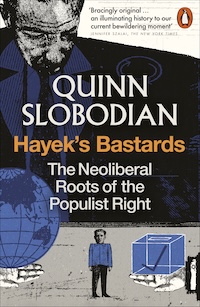
Slobodian covers this fusion of right-wing ideas in his book Hayek’s bastards: the neoliberal roots of the populist right.
Nicholas Brown of ANU has a review of Slobodian’s book in Inside Story, with the cryptic title Frontlash. (Meaning that the populist right is not a backlash against neoliberalism, but has actually been spawned by it.) Christopher Pollard of Deakin University has a review, in more accessible style, in The Conversation, with the descriptive title How the neoliberalism of “Hayek’s Bastards” changed the world – and fuelled the rise of the populist right.
Lest we think this is all in the rarefied world of ideas discussed in old universities somewhere in the Austrian mountains, Gareth Hutchens describes some of the proceedings at a conference organized by the Australian movement Advance, the political movement to which James Packer has recently donated $150 000, and Gina Rinehart’s Hancock Prospecting has donated $850 000. It has also received a substantial donation from the Henroth Discretionary Trust, the family trust of Jillian Segal’s husband John Roth.
Gareth Hutchens describes the main proceedings at that conference. Speakers included a collection of far-right luminaries – Tony Abbott, Maurice Newman, Moira Deeming, Alex Antic and Senator Jacinta Nampijinpa Price. The most shocking aspect was a speech by Benjamin Harwell, “Research fellow for Judeo-Christian Western Civilization”. in which he asserted that Angela Merkel did more damage to Germany’s fabric than the Nazis.
Anyone who thinks our far right is just an assembly of aggrieved and bewildered twerps should take note.