Politics
The Liberal Party’s election review

Where it was written and hidden
It’s all about campaigning against Labor and independents, rather than developing policies.
It was bound to come out. Failure calls for identification of a culprit, and that culprit is the person who has taken on the title of “leader”.
Dutton is the scapegoat for the party’s catastrophic election loss. (And Ley is the scapegoat for its subsequent dreadful poll performance.)
This is the way immature groups of people behave. Rather than deal with their own failures, they send the scapegoat off to the desert with their troubles.
The review, now tabled in Parliament, tells us little we didn’t know already. Its assessment of Dutton is scathing – unnecessarily so. It describes a shambolic campaign, too tightly controlled from the centre. And it identifies the party’s lack of appeal to women and to young people. Because they were already in the public domain there was no need to suppress those findings.
The authors’ concern about failures in the party’s campaign comes out in 17 recommendations, which come close to generic guidance for any party contesting an election. And that’s where the report’s weakness lies, because it’s weak on policy.
That isn’t to say it ignores the importance of policy, but it tends to see “policies” as elements of an election campaign in the way an advertising agent would choose gimmicks for a product promotion. It is critical of the assault on working-from-home, because it didn’t go down well. There is mention of the nuclear power policy: there was nothing wrong with the policy itself, but they hadn’t taken the time to explain it. Jane Hume’s “Chinese spies” comment, and Jacinta Nampijinpa Price’s Make Australia Great Again were costly gaffes. And so on. The message that comes across is “we had a good product but we really screwed up the sales pitch”.
No. “Policies” aren’t bits and pieces thrown in to help a campaign along. In fact the word should be in the singular, about a party’s “policy” – a coherent values-based set of principles, from which particular measures or initiatives can be developed. But the word “policies” in the plural appears 26 times in the document. That’s telling.
For example the nuclear power proposal would have made sense if it had been an aspect of an overall policy of state-based nation building, including highways and fast rail. But it was (and still is), inconsistent with the party’s “small government line”. If the party had a policy bringing national security and multiculturalism together, Jane Hume would never have thought of making such a silly statement about spying Chinese.
The report’s recommendations hardly touch on policy. I have, however, found two that come within a cooee of a concern with policy:
Recommendation 11: Future Federal Campaigns should assemble a "Red Team", a group of experienced people to anticipate ALP campaign initiatives and responses to proposed Liberal initiatives and policies.
It refers only to the campaign phase, and it’s reactive. By the time an election is called it’s far too late to be developing policy. But at least it acknowledges that some people think about policy when they vote.
Recommendation 15: Broadening the support base is necessary if the Party is to reflect modern Australia. The Party must develop a renewal strategy for engagement with multicultural communities and young people in which MPs are held accountable for their engagement efforts.
That’s more promising, but only if it’s about listening, rather than selling. It would work if it guides the party into bringing young people and migrant communities into the policy development processes, and if the party is ready to break from some of its shibboleths, particularly its obsession with “small government” and its indifference to wealth inequality. But if it’s just about sales gimmicks, it will work as badly as Coles’ “Down Down” campaign.
The overall tenor of the recommendations is combative. It’s about those horrid Labor and teal candidates: the teals “must be confronted head on”, with dirt campaigns if possible. Labor and independents are seen as enemies, rather than as political rivals.
The Liberal Party still sees itself as the natural party of government. All it has to promise is that it will keep Labor out of office, and to do everything to get back into office itself when Australians have been silly and reckless enough to elect a Labor government. There’s no need to develop a policy platform, any more than an airline captain has to share her flight plan with the passengers, because the men (and occasional woman) of the Liberal Party know what is right.
Where it all went wrong
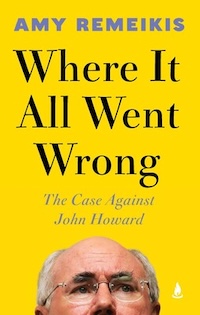
John Howard lost office 19 years ago, but the trail of damage he left behind is still with us.
“He gutted the nation’s soul” is how Amy Remeikis summarises John Howard’s 11 years as prime minister, in her book How it all went wrong: the case against John Howard.
Dense with well-researched evidence of maladministration, her book reads like a criminal prosecutor’s brief. But it’s not about criminal activity: rather it’s about an indolent administration lacking any vision for Australia – unless one could call mediocrity a vision.
The times suited Howard. His administration enjoyed the delayed benefits of the Hawke-Keating economic transformation, and a boom in commodity prices as China embarked on its extraordinarily rapid industrialization.
But rather than re-investing the proceeds to strengthen the economy, his administration wasted the boom in public revenue on tax cuts, mainly for the already well-off.
With the help of the Murdoch media he redefined “economic management” to refer to the bookkeeping task of running a fiscal surplus, while he neglected to invest in the infrastructure and human capital that could have strengthened the country’s economic resilience. He distorted the taxation system so as to prioritize short-term financial speculation, particularly in housing, while discouraging long-term investment in productive assets. He and the economic lightweights around him did not understand the difference between money and wealth, and they had no notion of the common wealth.
To Howard a successful economy was a business-friendly low-wage economy. To this end he pursued labour relations and immigration policies deliberately designed to suppress wages. This suited existing businesses, particularly those in the fossil fuel industry, who didn’t welcome the disruption of structural change.
Most of Remeikis’s work is dedicated to Howard’s shortcomings, but her main point is about the durability of the damage Howard inflicted on Australia. He wasn’t Australia’s worst prime minister: that honour is contested between Billy McMahon and Billy Hughes. But his damage to the Australian economy and the nation’s political culture is enduring, 19 years after the nation and the voters of Bennelong rejected him. To quote Remeikis:
You could say John Howard’s greatest achievement is the modern Labor Party. Even with the historical majority it won in 2025, and the complete cratering of the Liberal Party vote, Labor seems afraid of making any sort of progressive change because of what could happen, of how someone could twist debate and send them back into the political wilderness.
She is puzzled by the way there is still such reverence for Howard. Perhaps it is just our political immaturity: his idea of political management was a “relaxed and comfortable” electorate, which he achieved by avoiding the pain of structural change. His was a buy-now-pay-later administration, and we are still paying.
Anyone who was around between 1996 and 2007 could add many more of Howard’s failings than Remeikis covers – his cringeworthy deference to the British monarchy, his politicization of the Commonwealth public service, his changes to superannuation to make it into a tax-evasion vehicle for the rich. She was probably under pressure from her publisher to keep it to 166 pages.
She gives an even shorter presentation of her work on Radio National, in a 25-minute interview with Fran Kelly. Kelly comes across as the passionate defender of Howard’s legacy. Is this a form of Socratic questioning, or is Kelly really one of Howard’s loyal disciples? Whatever motivation lies behind Kelly’s assertive defence of Howard, Remeikis pursues her case with the conviction of a well-briefed prosecution lawyer.
Judith Brett has a Conversation contribution summarising Remeikis’s book: Blame John Howard for our housing and migration woes, says Amy Remeikis – but is he due some credit too?. In Howard’s defence she mentions the GST as a significant economic reform. That is fair comment, because while on first glance it is regressive, as Remeikis points out, once one digs into its full distributive effects, it is actually a progressive reform. Personally I would add further independence of the Reserve Bank as the Howard government’s only other economic reform, but neither this nor the GST compensate for his government’s neglect of structural reform, gutting of state capacity, and commodification of housing.
What is social cohesion?
“Social cohesion” has become a loosely-used fashionable term. Julian Hill describes how the government understands social cohesion and multiculturalism.
Racists in One Nation and political opportunists in the Coalition parties have formed an unholy alliance to mount an attack on multiculturalism, involving misrepresentation of how multiculturalism has developed in Australia, as if it’s some free-for-all anarchy tearing the country apart.
In a speech to the McKell Institute – Proudly embracing modern Australia – Minister for Citizenship, Customs and Multicultural Affairs, Julian Hill, strikes back against those peddling lies and misinformation. He acknowledges that there have been “stresses, fractures and fragility in social cohesion”, but the damage is repairable.
He states what the government understands by “social cohesion”:
Simply put it is how we live well together. How we treat one another, how we debate our differences, how we share a sense of fairness even when we disagree, how we preserve what we've built. Social cohesion is about respect, participation, belonging, trust, and shared responsibility and obligations. Listening before judging, helping a neighbour, engaging in civic life, and accepting and respecting the institutions that bind our society together.
Drawing on the government’s 1989 National Agenda for Multicultural Australia he describes how multiculturalism has developed in Australia, summarising its key dimensions:
The right to cultural identity (within limits);
The right to equal opportunity and fair treatment (social justice); and
The need to recognise and utilise the diverse skills and talents of migrants (economic efficiency).
He then refers to the obligations for everyone, native and immigrant:
A shared and unifying commitment to Australia first and foremost;
Acceptance of the basic structures and principles of Australian society including the Constitution, tolerance, Parliamentary democracy, equality and English as the national language; and
Accepting the right of others to express their views and values.
He calls out those who are deliberately undermining social cohesion:
Negative attitudes are particularly apparent against: Australians who are Muslim or Jewish; and certain ethnicities – notably African, Middle Eastern, Indian and Chinese heritage Australians – curiously, all groups that the Liberal party has picked on or failed to defend in recent years.
He also identifies overseas forces, including the right-wing Conservative Political Action Conference. And he has a warning for the left: those with “instinctive values-based focus on rights”, should “remember that there are limits to cultural expression” and should “champion the obligations that come with being Australian”.
Looking more deeply than at partisan politics, he warns about the growing proliferation of faith-based school systems as a hindrance to social cohesion. If we are to have faith-based schools, maybe we should also have mechanisms to ensure that children come together, as is the practice in Singapore.
Hill summarises the main parts of his speech in a discussion with Patricia Karvelas, starting with his views on January 26 (keep the date is his view).
He is distressed to see that the extreme right has taken over the Australian flag. Perhaps we should accept that and let Nazis, white supremacists, sovereign citizens and the aggrieved keep it. Like the Canadians we should be able to develop and identify with our own flag, not a colonial-era symbol that gives prominence to the flag of a distant country with its own culture and its own interests. There are plenty of contending designs, and there is a lobby, Ausflag, ready to be resurrected.