Economics
The IMF’s report on Australia’s economy
The IMF reports that Australia’s economy is travelling well, while suggesting that the government strengthen its revenue base. This is quite at variance with the Coalition’s advocacy of fiscal austerity.
The IMF has produced an assessment on the Australian economy, summarized in a short document with a long title: IMF Executive Board Concludes 2026 Article IV Consultation with Australia. That reads as a report on a well-managed economy with the capacity to deal with external challenges:
Directors emphasized that near-term macroeconomic policies should remain agile and responsive to external shocks. In this context, they commended Australia’s robust institutions, flexible markets, agile policy toolkit, and flexible exchange rate, which position the country to manage external risks from trade policy uncertainties and tighter global financial conditions.
The more detailed document goes into Australia’s economic challenges – low productivity and the related problem of inflation remaining elevated, housing supply and affordability, and the challenge of achieving fiscal balance over the medium term.
It does not join the right-wing chorus calling for cuts in spending and taxes – the Taylor mantra – but it does call for reform of spending and taxes. In contrast to the Coalition scaremongers, it does not call out government debt. In fact it states: “General government public debt remains low and the risk of sovereign stress continues to be assessed as low”. (But it does warn of a build-up in household debt.)
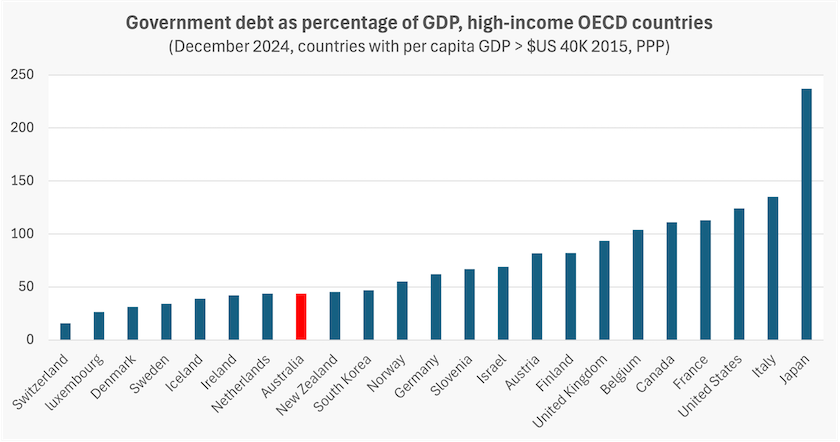
Confirming that assessment on debt, the chart below, compiled from Trading Economics data, shows government debt as a percentage of GDP for all high-income OECD countries. In spite of the big Covid deficit, Australia’s government debt is low in comparison with similar prosperous countries.
On spending, it emphasizes the need for efficiency improvements (a perennial recommendation). Notably it states that “Infrastructure spending should be protected given the potential to boost productive capacity”, effectively calling out the Reserve Bank’s disregard for the investment-suppressing effect of elevated interest rates.
Its main recommendations relate to revenue reform. They are about securing our public revenue base, making it fairer, and less likely to result in resource misallocation. To quote in full:
A high reliance on direct taxes and a relatively high effective cost of capital hinders investment and productivity growth and suggests there is scope for tax reform. A comprehensive reform package should aim at improving the efficiency, equity, and sustainability of the tax system. Options include an increase in Goods and Services Tax (GST) rate and removal of GST exemptions, offset by changes to Corporate Income Tax (CIT) settings. For instance, an allowance for corporate equity and/or lowering the CIT rate could be coupled with compensatory measures such as adjustments to resource rent taxes. The productivity commission’s proposal to adopt a cash flow tax accompanied by a cut to CIT rates could achieve similar goals, but the relatively untested approach will come with some implementation risks. Tax breaks, including superannuation concessions and capital gains tax discount, could be phased out to generate a more equitable and efficient tax system.
That’s a bold agenda for the Commonwealth budget, the hardest part of which would be raising the GST, because all increased revenue would flow straight to the states. The authors are concerned about states’ capacity to service their debt without resorting to distortionary taxes. The other impediment to raising the GST is that any proposal to do so invokes an immediate response from those who see only its immediate regressive effects, rather than its distributive benefits in a broader context, once the nature of state spending on human services is considered.
The authors give a general endorsement to policies directed to climate change and our energy transformation:
Australia’s green transition, including the recently announced 2035 targets, present opportunities for enhancing investment, productivity, and diversification, while supporting climate goals.
The “diversification” referred to in that statement relates mainly to export of critical minerals, and the use of renewable energy to achieve more processing in Australia.
It’s a defensible set of recommendations, far more responsible and realistic than the Liberal’s austerity program of emasculating the public sector while imposing a massively expensive nuclear power industry on the Australian economy.
Perspectives on Australia’s mixed economy
A small relative shift from private consumption to public consumption is a structural adjustment that maintains a balanced economy.
A prerequisite for national prosperity is an economically responsible balance between what is funded and provided by the private sector in markets, and what is funded by taxes and provided by the public sector.
The historical textbook example of a country getting it wrong is the Soviet Union, which had no place for the private sector.
Countries can fail in the opposite direction by putting too much reliance on the private sector to do things that can be done at much lower cost in the public sector, usually while achieving more distributive justice. Examples where the private sector does an expensive and inequitable job include funding health care through private insurance and funding roads with tolls. More generally, countries guided by a “small government” ideology as an end in itself tend to skimp on public spending that improves productivity over the long term, including education (at all levels from early childhood through to postgraduate), research, and transport, energy and communications infrastructure.
For many years, guided by neoliberal ideologies, a public misunderstanding of economics, and an anti-public sector bias in parts of the media, Australian governments, particularly at the Commonwealth level, have tried to prioritize public expenditure constraints over the provision of necessary public goods. As a result Australia has been struggling to get by with almost the lowest taxes and the smallest public sector of all prosperous “developed” countries.
For a long time we were managing with roughly balanced public budgets, keeping taxes and spending at around 27-28 percent of GDP[1]. But over the long term, if the balance between private and public provision of services is to be maintained, public expenditure has to rise. This is because many important public services, including school education, health care and policing, are intrinsically labour-intensive. They do not enjoy the extraordinary advances in productivity that have seen the relative prices of private sector goods fall over the long term.
Also the public budgets of “developed” countries like Australia have additional budget demands resulting from an ageing population. And in most “Western” countries, including Australia, there are calls for greater defence spending.
Over the last three years, there has been a significant jump in Commonwealth spending, from 24.3 percent of GDP, the last of the Coalition budgets, to 26.9 percent of GDP, the most recent budget of the current government. Because it’s easy to cite these figures out of context, as right-wing commentators have been doing, these points are shown (with red circles) in their broader context in the chart below which plots a 25-year run of Commonwealth receipts and outlays.
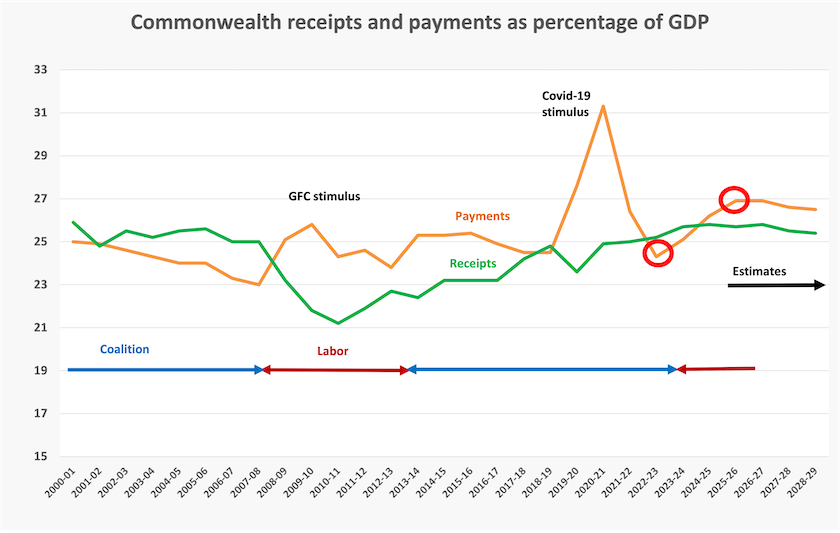
The growth in Commonwealth spending has been mainly in the care economy, particularly health care and disability services.
This growth in public spending has been a significant contributor to the growth in GDP over that period, leading to a claim that because that growth stems from public sector activity, rather than private sector activity, it’s simply a statistical artefact, rather than real growth. Coalition spokespeople and right-wing journalists have been the main pedlars of this line.
This idea has no basis in economic theory. A moment’s reflection exposes its absurdity: a teacher in a private school is doing something useful while a teacher in a public school is just a part of a taxpayer-funded unproductive overhead. Your car is something of value, but you’d be better off if there were no roads. Reductio ad absurdum.
But the idea that no good comes from the public sector is not just fringe ideology: it has long been a core of the Liberal Party’s stated beliefs, which state that “businesses and individuals – not government – are the true creators of wealth and employment”. It’s one of those statements that seems to make sense until you think it through, particularly when it is repeated in various forms by Angus Taylor and James Patterson, who are adept at delivering economic gibberish in a glibly assured manner – a manner that is too easily mistaken for expertise.
The perspective from e61 – choices to be made
The e61 Institute has released a paper Rising pressures, fading discipline, a review of Australia’s fiscal sustainability, which covers the same ground of rising government outlays, and the same drivers of growth in these outlays. On Radio National Michael Brennan of e61 summarises this work.
The main contribution of this report is a consolidation of Commonwealth and state public accounts. (The chart above covers only Commonwealth budgets.) State spending is growing strongly, particularly on infrastructure, which means state debt is growing strongly.
That is not to criticize that spending – our population is growing at a high rate and there is an infrastructure backlog. But it does mean we tend to understate the fiscal pressure faced by our governments, particularly our state governments, which have the burden of providing labour-intensive services as well as the burden of financing that debt. We don’t have an imminent debt problem, but we don’t have the taxation structure to provide for growing demands on public budgets, particularly state budgets.
The report identifies another driver of public expenditure growth, the “increased universalism of government services”, which indicates a change in the nature of government services being delivered. As Brennan explains, we are moving away from targeted spending on services and towards a more European style of universalism. That is not in itself a problem, but it seems to arise from a slow drift rather than a conscious policy decision. We should have a mature debate on our public expenditure and revenue choices. (The authors at e61 are too polite to mention Taylor’s determination to make sure wedon’t have an informed debate on public finance.)
A banker’s perspective, with a focus on inflation
Pat Bustamante of Westpac analyses the growth in public spending that started during the 2008 financial crisis: As big as the mining boom: the rise of the public economy. In round terms public spending – by all three tiers of government, capital and recurrent – has risen from about 27 percent to 34 percent of gross value-added. His analysis looks not only at the specific sectors where spending has grown, but also at the wider effects of that spending: for example how expenditure on health has had consequences on the construction sector because new hospitals have been built.
His analysis is free of political spin. The shift in economic activity is “not inherently negative” he writes. The only hint of a value judgement is where he points out that this shift has led to capacity pressures and higher inflation in those industries where there has been the greatest growth in government spending. That’s a transitional problem until more resources can be secured. For example that may mean that more health professionals will be trained or brought to Australia as immigrants (provided some populist idiot doesn’t cut immigration sharply).
A once-off re-adjustment of prices, associated with a change in public and private spending priorities, will have some effect on indicators that are used to detect inflation. But that should be a once-off change: it’s not the same as the self-reinforcing economy-wide inflation that is of legitimate concern to monetary authorities. And it is certainly very different from profligate public spending: the Albanese government upholds a tradition that many would claim to be unnecessarily fiscally conservative.
1. These are rough figures, covering all three tiers of government. We do not have a good set of consolidated public accounts, partly because for many services, such as state government motor vehicle registration, and local government rates, it is difficult to distinguish between user charges and taxes. ↩
The Reserve Bank’s mandate
So-called “moderate” Tim Wilson reveals his hard-line Thatcherite economic values,.
Almost immediately after being appointed “shadow treasurer” (whatever that means) Tim Wilson floated the idea that if the Coalition is elected to government it should review the Reserve Bank long-standing dual mandate – the mandate that requires it to pursue price stability and full employment. He made it clear that he wanted to see the Bank directed by a single price stability mandate.
The idea didn’t last long: by yesterday it was dead.
The Guardian’s Patrick Commins reports on Wilson’s idea: Is Tim Wilson an “inflation nutter?”. Unsurprisingly it didn’t go down well with the ACTU, and it gave the government a chance to accuse the Coalition of being indifferent about unemployment.
The incident is an important reminder to journalists and others who have been labelling Wilson as a “moderate”, presumably because he has taken a liberal position on some social issues. But as he has previously demonstrated in his defence of people who have misused superannuation tax breaks to accumulate huge fortunes, he is an economic hard-liner – probably much more hard line than the populists in the party seeking to conquer Pauline Hanson’s territory.
Health policy – the curse of private insurance
Private health insurance is a high-cost and inequitable way to fund health care. The government should stop subsidising it.
A 4.41 percent rise in government-approved private health insurance premiums was given media prominence last week.
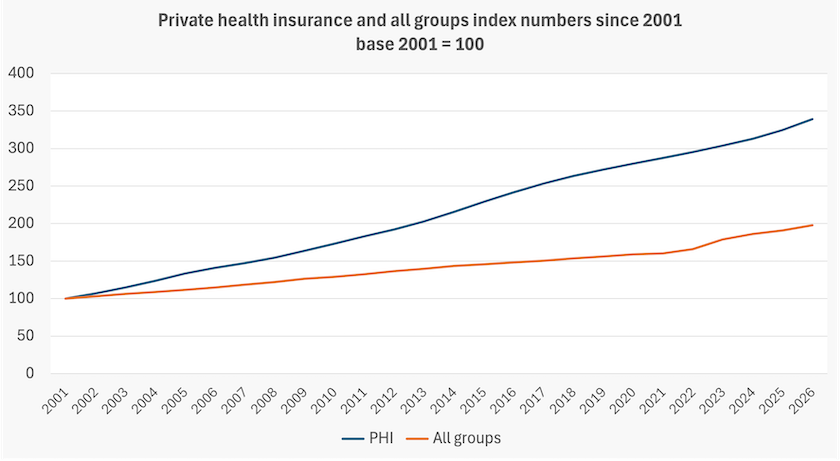
For many years the price of private health insurance has been running ahead of consumer inflation. The graph below shows that over this century so far, while the CPI has risen by 100 percent, private health insurance premiums have risen on average by almost 250 percent. (This graph includes the latest rise.)
One may have expected that many people, in response to these rises, (burdened by a supposed “cost-of-living crisis) would have dropped private health insurance, but membership has been remarkably stable.
There has been a response however, in that people are downgrading their insurance policies, to choose lower-cost products with exclusions. In 2020, 58.5 percent of policies had exclusions; last year 68.4 percent of policies had exclusions.
Some people keep up private insurance simply to avoid the Medicare Levy Surcharge [2]. They buy the lowest-price hospital policy on offer, with no intention of ever using it. That probably explains why coverage has stubbornly stayed at around 45 percent.
But others who buy private insurance try to choose a policy that covers their expected needs. Illustrating the complexity of choosing cover the ABC last week ran a story aabout someone who believed she had accident cover, but when she fractured her shoulder in an accident she discovered she was not covered and would have to pay $30 000. (She probably could have had free care at a public hospital.)
There is an argument about who is responsible for the inflation in private insurance premiums. You can hear a discussion on the ABC in which the private hospital lobby defends hospital price rises and gently suggests that the insurers are making excess profits: Health fund profit criticism amid premium increase.
They don’t get too animated, however, because if each side were to expose the shortcomings of the other, the high cost-structure of private hospitals would be exposed, as would the profits and high administrative costs of private insurance. In comparison with Medicare, which has an administrative burden of only 5 percent (even once the cost of tax collection is accounted for), the administrative cost of private insurance is 15 percent of premium income.
Private insurance is a useless product, that does at high cost what Medicare can do far better. It’s a misnomer to call it “insurance”, because most policies limit their cover, leaving the consumer with open-ended risk. All they offer is a bit of help in paying bills rather than insurance. Tax incentives for private insurance, particularly the Medicare Levy Surcharge, effectively use taxpayers’ funds to subsidize queue jumping for health care.
The gratuitous advice the insurers, the government and so-called consumer advocates give to the public is to “shop around” for the cheapest product. It’s the generic advice that applies when privatization has resulted in a confusopoly of prices.
If we had a government more concerned with providing an equitable and efficiently-run health system it would abolish incentives for people to hold private insurance and subject it to normal taxes, such as the GST. After all the original intention of Labor governments was to introduce universal tax-funded health insurance, and it went through massive political struggles to achieve it, only to see subsequent governments, Coalition and Labor, weaken it. If people were not buying private insurance taxes would have to rise, but because private insurance is so costly any rise in taxes would be more than offset by savings as people abandoned private insurance.
Contrary to claims by lobbies, without private insurance private hospitals would remain as part of the health care delivery system, provided they can meet the efficiency standards of public hospitals. (During the Covid period many private hospitals provided services under contract to Medicare.) There is no logical reason why private hospitals should be tethered to private insurance. And private insurance can go the way of the fax machine, the gas stove and the incandescent light bulb.
2. The Medicare Levy Surcharge is a tax surcharge imposed on people without private insurance. The surcharge kicks in at a 1.0 percent rate for an income of $101 000, rising to 1.5 percent for an income of $158 000. When the surcharge was originally introduced by the Howard government it was to apply only to people with high incomes, but over many years governments failed to lift the threshold. ↩
Migration policy needs improvements, not cuts
It’s about skill shortages
Occasionally in Canberra some amazing policy paper will fall off the back of a truck. It’s always lacking in clear authorship, and is usually marked “Secret” or a higher classification. Maybe it’s left in a conference room or in the back of an airline seat (business class).
So it seems to be with the first draft of the Coalition’s immigration policy, that has fewer claimed owners than a battle-hardened pregnant stray cat.
As Abul Rizvi explains on a short Radio National clip, whenever net overseas migration climbs above 250 000, complaints abound about stress on housing and infrastructure. When it falls below 200 000, complaints arise about skills shortages.
On the same clip Simon Walsh of Redbridge pollsters says that the immigration level is not a burning issue among voters. That suggests that the Coalition’s stated preference for lowering migration has more to do with winning over the One Nation base than any wider electoral appeal.
The most well-argued complaints about migration are coming from those concerned with skills shortages – health care professionals, aged care workers, mechanics, hospitality workers, construction workers – almost every occupation other than hairdressers and influencers, and that has been the case for the last four to five years according to Jackson Taylor, of Roam Migration Law speaking on Radio National. He is critical of the bureaucracy in the migration system, and the delays and cost in sponsoring skilled migrants. He is also concerned about the damage done by those who are misrepresenting migration numbers.
A reader has brought to our attention a US study on the effect of migration on the nation’s health by the National Bureau of Economic Research: Is Immigration Good for Health? The Effect of Immigration on Older Adult Mortality in the United States. Even in the absence of specific targets directing migrants to health care, for every 1000 new migrants there are another 142 health care workers, and meaningful reductions in mortality.