Our (painfully slow) energy transformation
Saving the budget while saving the planet
The Superpower Institute puts forward a way to meet our emissions targets, while improving equity, achieving allocative efficiency, and easing stress on public budgets.
We’re not on track to meeting our 2030 or 2035 targets for reducing emissions, let alone our 2050 target. Most of our claimed achievements have come from changes in land-use – sequestering more carbon in growing forests and in the soil – but there are strong arguments that we are overstating the benefits from land-use. Just this week the Wentworth Group of Concerned Scientists published their report on vegetation clearing in New South Wales, which strongly suggests that in that state at least, farmers are clearing land at a high pace, there is little control on land clearing, and the government doesn’t have a reliable way to track violations of land conservation laws.
Otherwise the only sector in which emissions have been clearly declining since 2005 is electricity generation, as shown in the chart below, which has been prepared from data supplied by the Superpower Institute.
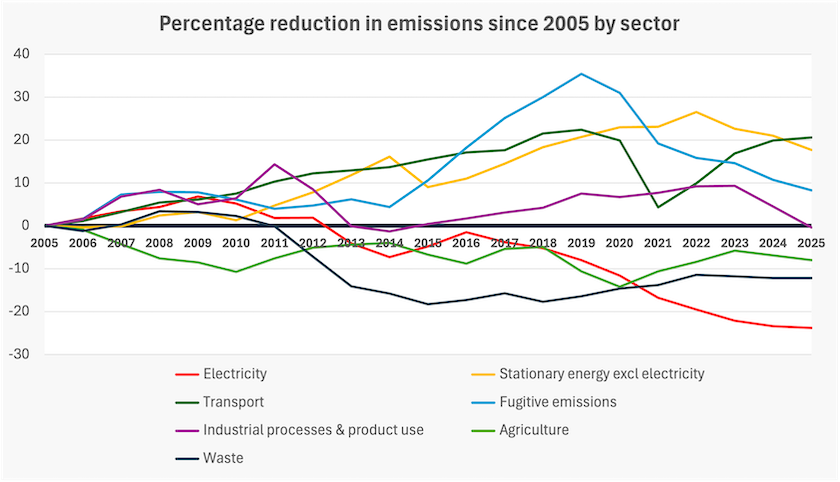
This reminder of our lagging sectors is in the Institute’s paper The case for pricing pollution: reducing emissions, strengthening the economy, and delivering a fair share for Australians.
Their path to bringing all sectors on track is to set a carbon price, collected as public revenue. They call it a “polluter pays levy”. Economists would call it a market mechanism that brings to account the externalities of emissions, while the anti-renewable lobby would call it a “tax”. There’s nothing radical or novel about carbon pricing: it’s about as mainstream economics as you can get.
That carbon price would be supplemented by a “fair share levy”, collected mainly from gas exporters, modelled on Norway’s special tax on petroleum income. Again, nothing radical: economists have long been pointing out that even in comparison with our other lightly-taxed extractive industries, gas is very much undertaxed.
The Institute compares our performance in capturing public revenue from our fossil-fuel resources with the practices in other countries. As shown in the chart below, we probably have much more revenue-raising capacity: even the USA does better!
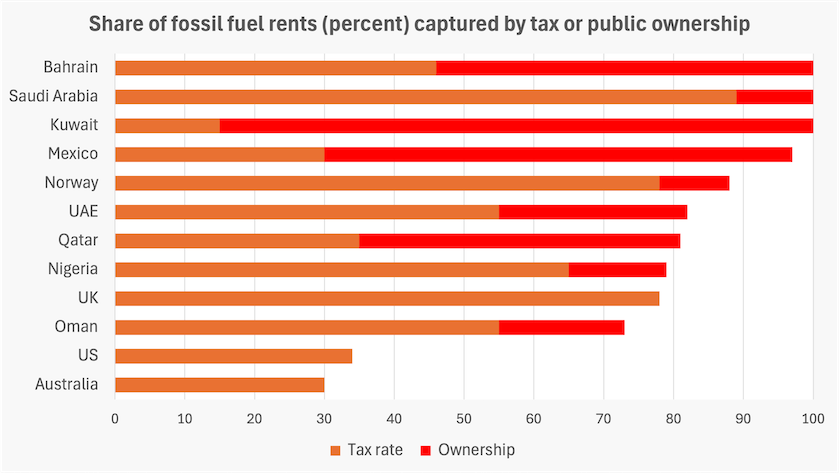
The authors model the fiscal benefits of these two levies, and find they would add an average of $36 billion a year, or around d 1.3 percent of GDP, as in the graph below:
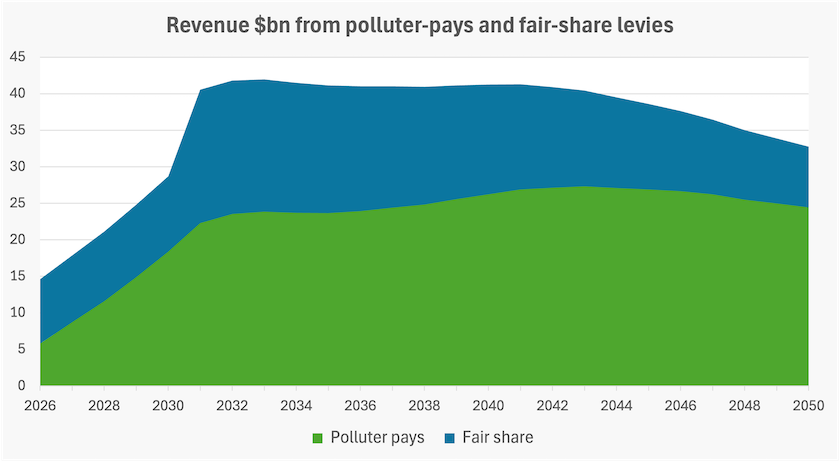
Some of this revenue would be directed to households to help with their costs in the energy transition – for example in phasing out gas – and some would be directed to helping businesses cope with the transition. Both levies fall over the long term but it’s evident from the Institute’s figures that they are looking at net zero by 2050 with offsets. Otherwise both levies would be falling to zero.
All you want to know about electricity
The ABC’s Daniel Mercer explains the economics and engineering of electricity supply in plain language with heaps of illustrative graphics.
Circulating through partisan media are lies about electricity prices and bills, and even in more neutral media there is a great deal of confusion.
Much of the confusion is about electricity prices and electricity bills. In simple terms government policies influence prices, while your decisions determine your electricity bills.
People are wondering why, if wholesale electricity prices are falling as a result of improved renewable penetration, prices per kWh aren’t falling.
That’s because about 60 percent of the price is to pay for transmission, distribution, and commissions paid to “retailers”. These costs are all elevated because of decisions made around 20 years ago to privatize state-owned utilities. That was poor public policy, which our overly-cautious Commonwealth government is reluctant to rectify.
And some people find it hard to break from the “base load” model of decades ago, when big coal-fired stations had to keep spinning capacity running 24/7, and consumers were encouraged with special tariffs to use that spare capacity in the middle of the night, usually to heat hot water. That’s all changed, and now we’re concerned with “dispatchable” electricity, in markets that match demand and supply, mediated through storage. That lowest cost is now during the day.
The ABC’s Daniel Mercer has a post Big swings in Australia's electricity market have a frustrating effect on our power bills. That’s a poorly-drafted headline for a well-written explanation of how electricity markets are operating. It’s a particularly useful reference document if you have been subject to Dan Tehan’s or Ted O’Brien’s anti-renewable rants.
The Grattan Institute’s Tony Wood covers much of the same ground in his Conversation contribution Renewables over 50%, wholesale prices down – is the energy transition… succeeding? It’s more about the trajectory of electricity demand and supply. Like most engineers and economists who study electricity markets he’s sure electricity prices will fall, but that will take time as we catch up after years wasted as policy stalled.
Rooftop solar and batteries
The government’s home batteries program, initially budgeted to cost $2.3 billion, required another $4.9 billion allocation. That’s economically fortuitous.
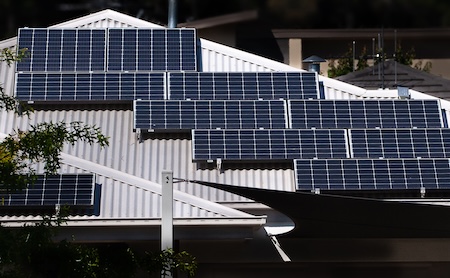
They work better with batteries
There are now 4.3 million rooftop photovoltaic installations in Australia, capable of providing 28.3 gigawatts of generation capacity.
OK – these numbers don’t mean much in isolation. To put them in perspective, there are 9.3 million households in Australia, and the total generating capacity of the National Energy Market (roughly most of Australia minus Western Australia) is about 100 gigawatts.
But the big news from the Clean Energy Council is about a huge uptake of household-scale batteries, revealed in its Rooftop solar and storage report, covering the second half of 2025. Over that period, encouraged by the government’s Cheaper Home Batteries Program, households installed as many batteries as they had installed over the previous five years combined. By now around half a million houses would have batteries.
This scheme was announced in the election, and came into effect in July. The initial budgetary allocation was $2.3 billion over four years: this was snapped up within six months. It has been allocated further funds, now budgeted to cost $7.2 billion over four years. It has also been modified to spread it further. Rather than a flat subsidy per kWh capacity, the highest subsidies apply only to the first 14 kWh capacity, which is around the lower limit of households’ daily use. Lower subsidy rates apply to higher capacity batteries. (Details are on the program’s website.).
Normally such a budgetary blowout would send Treasury into a panic, and would attract sharp criticism from the Coalition’s anti-renewable mob, but as the uptake shows it’s a popular program. And it has clear economic benefits not only for those who install batteries, but also for all electricity users, because if people with batteries have kWh to spare during the evening peaks, as solar supply falls and demand rises, that extra power can reduce the need for expensive coal and gas. Because spot prices are set by the highest-cost suppliers, reduced demand for coal and gas in the early evening would allow lower average prices.
It also helps overcome the current excess of solar power during sunny days. The ABC’s Catherine McMahon has an explanation of the scheme in a post Household battery uptake booms on back of “game-changer” rebate. She also explains a related scheme, due to be phased in in July this year, the Solar Sharer Scheme, which will result in consumers on the default market offer having three hours of free electricity in the middle of the day.
We don’t know why the government misjudged the demand for the scheme so badly. There are many possible reasons, which should provide good research projects for students looking for a thesis topic. Maybe people who had installed panels were so disappointed by low feed-in tariffs that they jumped at a program that would justify their investment. Maybe the government believed the stories about a “cost-of-living” crisis, forgetting that there are plenty of people who can easily stump up with the $10K or so co-payment for batteries. And maybe the enthusiasm has less to do with specific calculations of savings, than with people’s loathing of privatized electricity companies: going off-grid is becoming a possibility for more and more households.
Who has voice on climate change policy?
The fossil fuel lobby finds friends in the media who are willing to give it a strong voice.
Although many Coalition politicians run the line that strong climate action is bad for business, businesspeople do not speak with one voice on climate change. Writing in The Conversation – These voices are the loudest in Australia’s climate wars – Christian Downie of ANU reports on the work he and his colleagues undertook to find who is actually dominating the climate policy debate in Australia. His conclusion:
Interestingly, there are more pro-climate groups than anti-climate groups. Most NGOs in our study tended to support action on climate change, including the Australian Conservation Foundation, Greenpeace and WWF.
Many of the business groups do not. But it’s not as black and white as this might suggest. Firms and business advocacy groups are not unified. A growing number of renewable energy companies now mobilise in support of climate policy, often through advocacy groups such as the Smart Energy Council.
He finds a strong plurality of interests in the groups making representations to executive government and to Parliament. But in the media fossil-fuel interests dominate.
A dumb idea for setting electricity prices
What happens when naïve economic dogma is applied to setting electricity prices.
When you get your electricity bill it comes in two components – a daily network charge and a price per kWh. The network charge is typically around $1.00 to $1.50 a day.
In what appears to be a stunning misapplication of basic economic principles, the Australia Energy Market Commission proposes that this charge be increased dramatically – perhaps five-fold – to pay for increases in network costs. Presumably at the same time the price per kWh would fall.
This proposal is explained (derisively), in a Renew Economy article Consumers face five-fold hike in network charges under regulator plan to take from the poor, and give to the rich.
The logic seems to be that because the cost of networks is fixed, regardless of how much electricity they carry, that aspect of electricity’s cost structure should be reflected in user’s charges. And if the network owners get too greedy, there will be consumer resistance to higher prices.
Letthe poor pay for them
That’s the sort of thinking that occurs when someone attends a few Economic 1 lectures, manages to recall enough of the basics to get a conceded pass, and goes on to work in a regulatory agency.
As the Renew Economy article explains, such a pricing structure would hit small consumers hard, while the lower per kWh charges would be great for those who want to heat their swimming pools in winter. And so long as we rely on some coal and gas, lower charges per kWh aren’t going to help in reducing emissions.
Had the authors paid any attention to the finer points of economics, they might have learned that prices should help allocate scarce resources efficiently and fairly.
For almost all people, except for those few with the means to go off grid, demand for an electricity connection is quite price inelastic. It’s something we have to have, which means there is no price response. In fact demand for the first few kWh of electricity – electricity we use for lighting, for our refrigerator, and for our basic appliances, is pretty well price-inelastic.
Therefore a tariff structure that provided free connection and say, 5 free kWh a day, would result in no different allocation of resources – provision of networks and of electricity – than at present. That’s what inelasticity means when it’s about “must have” goods. My colleague Miriam Lyons has even given it a name complete with alliteration – “First fridge free”.
We could fund FFF through general taxes. Or, better, we could fund it with steeply rising charges per kWh, so that there are stronger price signals applying to higher and less necessary use of electricity – for heating the dog kennel and running the beer fridge. Because it would reduce frivolous use of electricity it would have resource-allocation effects, including the benefit of helping us meet our emissions targets.