Public ideas
On the sources of public ideas
How public ideas make it on to the policy agenda — and how some ideas are suppressed.
Over the last few weeks the media, particularly journalists in the Parliamentary press gallery, have been paying a large amount of attention to the shifting fortunes of political parties. Although the party conflicts involve serious questions about energy policy and immigration, there seems to be a collective decision in the gallery that public policy is off the agenda for now.
Who determines what is on the policy agenda? Why are interest rates of such concern in our times, when in earlier times the economic policy focus was on unemployment, or the balance on current account? Why is immigration of such concern, when in times past, even when immigration rates were higher, a high rate of immigration was seen as uncontentious? Why is there so much fuss about electricity prices, when they are actually falling in real terms?
Then there are things “everyone knows” – the unquestioned conventional wisdom. Everyone knows that a budget deficit is bad and that a budget surplus is good. Everyone knows that the private sector is much more efficient than the public sector. Everyone knows that Australia has high taxes in comparison with other prosperous countries. Everyone knows that if you lock up troublesome kids crime reduces – it’s self-evident, isn’t it? (On analysis all the above are revealed as misinformation.)
The Italian philosopher Antonio Gramsci stressed that the political consciousness is based on public ideas, and that those ideas are nurtured in institutions that serve the interests of the wealthy and powerful. His vantage point was distinctly Marxist, but his more basic point is about the power of public ideas and therefore the influence of institutions and individuals that shape them.
Writing on the ABC website Gareth Hutchens describes the influence of economic philosophers, particularly Friedrich Hayek and Milton Friedman, on the public ideas that set the agendas for our political concerns. The title of his post, How the Atlas Network is shaping your life, even if you've never heard of it, has implications of conspiratorial secrecy, but what he describes are the reasonably easily-traced flows of ideas into our universities, media and government departments, often mediated by think-tanks.
Hayek was the libertarian, while Friedman believed in the order of well-functioning markets, but their ideas were sufficiently convergent to lead to ideological justification of the “small government” movements of Reagan and Thatcher and eventually the catch-all ideas of neoliberalism. Such was their influence that not only did Reagan and Thatcher put ideas on the policy agenda, but they also shifted thinking so as to remove some ideas from the policy agenda, such as nationalization of natural monopolies, limiting policy options to present only those favourable to the already privileged. One of Thatcher’s most-used policy statements would start with “There is no alternative …”, to cutting services, to privatizing government enterprises and so on.
Hutchens explains how neoliberalism underpinned the ideas dominant in the political establishments of English-speaking countries, initially in political parties of the right, but also among parties of the traditional left.
An example of Hutchens’ point of neoliberalism infecting parties of the left is provided by Australia’s experience with health policy. From 1945 up to 1975 Labor governments tried to abolish the curse of private insurance. But by the time Labor was next in office, even though the economic and distributive distortions of private insurance had worsened, the idea that it might be abolished was off the agenda: even those who had the freedom to describe policy options did not mention the possibility of doing without it. Abolition of private health insurance became as unthinkable as re-introducing slavery.
Hutchens describes how think-tanks have been intermediaries in this process, particularly right-wing think-tanks funded by industry interest groups, such as the Institute of Public Affairs. The Atlas Network, to which Hutchens refers, calls itself a loose association of right-wing think-tanks, with a mission to “litter the world with free-market think-tanks”.
Perhaps they need to update their mission statement, because as Dani Rodrik explains in an essay for the IMF – Against Rule-of-Thumb Economics – neoliberalism is largely a spent force, its failure having become evident in countries that followed its prescriptions. “It widened inequality within nations, did little to promote the climate transition, and created blind spots ranging from global public health to supply-chain resilience.” He goes on to write:
The original sin of the neoliberal paradigm was the belief in a few simple, universal rules of thumb that could be applied everywhere. If neoliberalism was economics in action, it was bad economics that was on display.
Neoliberalism may be on the way out, but right-wing influencers are as active as ever. Hutchens describes a network of think-tanks, political action associations, lobbyists, and politically active individuals with ideas that go well beyond and are often contradictory to the free-market ideas of Hayek and Friedman. Rather than advocating for the market, they tend to take the side of powerful interests, such as the fossil fuel lobby, which is intractably opposed to the idea of a carbon price – the market mechanism that would bring the energy market closer to Friedman’s ideal. In fact the think-tanks often become advocates for hard-right cultural issues that are way outside the economic sphere. He mentions, for example, that the movement Advance campaigned against the Voice to Parliament and is presently campaigning to prevent indigenous flags being flown. It’s hard to see what these have to do with free market economics.
Hutchens’ article is rich with links to definitions and descriptions of movements and think-tanks: for anyone who wants to understand the interests shaping public ideas in Australia it’s well worth reading and following its many links. In places his descriptions are vague, but that’s understandable, because many of the connections between think-tanks and associations are personal and informal.
In my view he underplays the extent to which these movements have morphed from free market advocacy, to a general support of populist authoritarian movements, as exemplified by the gatherings of the Conservative Political Action Conference. He seems to credit them with more intellectual rigour than they deserve: my loose description of CPAC would be “the mob who rushed to Mar-a-Lago following Trump’s election” – a bunch of oligarchs, con-men, spivs, political sycophants, political has-beens and wannabe intellectuals, more attuned to the allure of crony capitalism than to the economic rigour of Hayek and Friedman.
The return of slavery
Alan Kohler reminds us that another transition, as disruptive as the industrial revolution, may be developing.
We are shocked when we learn that part of the deal when the British Empire abolished slavery was for plantation owners to be compensated for their loss of property, in the same way as would occur now when a privately-owned company is nationalized. There was nothing for the liberated slaves, but this was all in line with normal accounting practices. Slaves, like machinery and buildings, were “owned” capital.
Alan Kohler in a 23-minute podcast explains how slavery will make a comeback.
The slaves will be robots, and in many ways their working conditions will be the same as those applying to slavery.
For many years there has been a transition from human effort to mechanical robots in workplaces, proceeding in the same way as other labour-capital transitions. But we are now seeing the proliferation of humanoid robots, that are not only human in appearance, but also, guided by artificial intelligence, are able to perform most human routine functions – and some non-routine ones as well.
Kohler says that if there is a substantial substitution of robots for humans, a clear consequence is unemployment. This isn’t some neo-Luddite assertion. In the industrial revolution as machines took over from labour other labour-intensive jobs emerged, but in the robotic transition most of those other jobs could be taken by robots.
Kohler reminds us that in our established capitalist economies, pay has been linked to work, but how are the proceeds of economic activity to be distributed if there are not many workers? Maybe we will need a universal basic income, but how do we finance it when there is no substantial base of workers paying income tax?
Those are the financial issues. Kohler also points out that work is central to humans’ identity and sense of value. It was Voltaire who said “Work keeps at bay three great evils: boredom, vice, and need”.
Why China is overtaking the USA
China is run by engineers who build stuff, the USA is run by lawyers who stop stuff from happening.
In the USA the elites with political power are lawyers. In China they’re engineers. Lawyers are good at stopping things from being built. Engineers are good at building things.
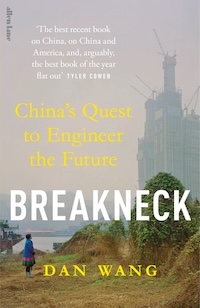
That’s how Dan Wang of Stanford University, speaking on Saturday Extra, explains the main administrative difference between the USA and China: How China is ruled by engineers and America is run by lawyers.
It hasn’t always been that way: up to around the 1960s the USA was the engineering powerhouse of the world, but it ran out of enthusiasm for doing things. By now, in terms of manufacturing capacity and infrastructure provision, China is well ahead of the USA.
Some of the discussion is about debt, which has financed what some judge as excess provision of infrastructure. But that’s not of great concern to the Chinese authorities, who seem to take more of a balance-sheet approach to investment (is debt funding something material and useful?), while in the USA attention is focused only on the amount of debt.
Wang has some telling observations on a comparison of Chinese and American trains. Australia may provide an even worse reference point.
His praise for engineers goes only so far, however. He is most critical of China’s utilitarian social engineering projects, particularly its (now abandoned) one child policy and its handling of Covid.
On the same theme economist Paul Krugman in a short post on his Substack – We’re number two! – writes that Trump has already ceded the future to China.
But the US can reclaim ground if it pursues a strong industry policy, centred on a transition to renewable energy and support for advanced technology. These are the programs initiated by the Biden administration, largely abandoned by the Trump administration, that have their variants in our government’s Future Made in Australia.
Wang is author of Breakneck: China’s quest to engineer the future