Politics
Human Rights Watch
The 2026 Human Rights Watch report covers the traditional violators, and draws particular attention to countries subject to democratic backsliding. Australia does not escape scrutiny.
The US features strongly in this year’s world review of human rights, published by Human Rights Watch. Australia, too, earns more than a passing mention for a range of human rights shortcomings.
It reports on the usual lineup of established authoritarian regimes, and draws attention to democracies on a path of suppression of human rights, particularly India, Turkey, the Philippines, El Salvador and Hungary.
In this regard the US is of particular concern. Its huma rights violations are nowhere near the intensity or scope of the world’s worst offenders, but its rate of democratic backsliding, associated with the expansion of executive power, is rapid.
This concern is not just about the US itself: it’s also about its global influence. To quote:
While US engagement with human rights institutions has always been selective, China and Russia have long pursued an illiberal agenda. They stand much to gain from a US government that now expresses open hostility to universal rights. China and Russia remain strategic rivals of the US, but all three countries are now led by leaders who share open disdain for norms and institutions that could constrain their power.
A right under threat
In turn, China and Russia exert strong influence on many other countries, including North Korea, Iran, Venezuela, Myanmar, Cuba, and Belarus.
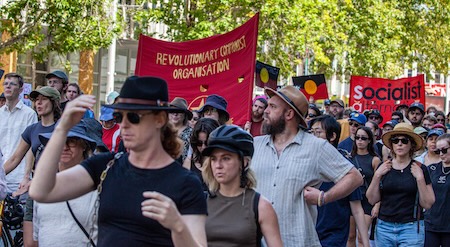
Australia does not escape attention. Treatment of asylum-seekers and over-representation of First Nations people in the justice system feature strongly in our country report. There is coverage of racism and ethnic discrimination in its many dimensions, complementing the focus on antisemitism that has dominated the media in recent years. While we may be reasonably free of institutional racism, Human Rights Watch is concerned about the ways authorities and people with voice respond to incidents of racism and ethnic discrimination. (The weak media and political response to the attempted murder of Invasion Day protesters is a strong example.)
Threats to the right to protest are also covered in our country report.
One Nation’s resurgence: will it fizzle out?
Thriving on the Liberals’ and Nationals’ conflict One Nation has surged in opinion polls. Where does it go from here?
Pauline Hanson and One Nation (the names used in ballots are fluid) have had a presence in federal politics since Hanson was elected in 1996, when she was the endorsed Liberal candidate for the Oxley electorate, covering Ipswich and outer-Brisbane suburbs. The Liberal Party disendorsed her before the election, but her name was on the ballot as a Liberal candidate and she took the seat off Labor with a 19 percent swing. It was in that Parliamentary term that she made her infamous statement about Australia in danger of being “swamped by Asians”, and asserted that government programs gave indigenous Australians advantages not available to other Australians.
It was a spectacular entrance, but it was the only time One Nation had a seat in the House of Representatives. In the subsequent election in 1998 it won a seat in the Senate, and 11 seats in Queensland’s unicameral Assembly. Otherwise its successes were only in state legislative councils, until it won four Senate seats in the 2016 double dissolution election, and has had Senators ever since – presently four.
Writing in the Saturday Paper – Pauline Hanson and the AI “slopaganda” election – Anna Broinowski fills in the details with a political history of One Nation, including the way John Howard maintained an ideological alliance with One Nation while keeping a public distance:
John Howard, who shares Hanson’s ideological allegiance to the pre-woke, Anglo-Australian values of the 1950s, won four federal elections by skilfully capitalising on One Nation policies and preferences, while publicly distancing himself from Hanson’s incendiary politics.
Broinowski goes on to describe how around the turn of the century the LNP felt so threatened by One Nation that a group of Coalition politicians bankrolled a legal case that saw Hanson jailed for electoral fraud (subsequently overturned on appeal).
She describes a party that’s able to target a significant but limited part of the electorate. It can appeal to its base because unlike a party planning to form government, it doesn’t have to present even the semblance of a realistic economic policy. It can go all out on a xenophobic platform, ignoring those parts of Australia where multiculturalism is well accepted. That’s why it can promote economically stupid ideas such as building coal-fired power stations and closing the economy through protectionism, and can produce explicitly racist promotional videos appealing to white supremacists.
One Nation sees opportunity in the troubles afflicting the Liberal and National parties. Successive election losses have seen the voting base of those parties, particularly the Liberal Party, shrink to a hard-right base, with political views that are closer to the voting base of One Nation.
Maybe here lies an opportunity to build a hard-right MAGA-style movement around the politics of grievance – perhaps a coalition of right-wing parties, but even better a single party, headed by One Nation’s charismatic luminaries – Pauline Hanson, Barnaby Joyce and Cory Bernardi.
At first sight it’s a well-considered plan. Or it would be if Australia had the same rural-urban divide as the USA, the same divisions in education, the same de-industrialized wastelands, and the same porous land border with a poorer neighbour. If that were our political demography and geography, by now the former Coalition parties would probably have completely merged with One Nation in a local MAGA movement and would be a serious contender to hold office federally.
But even though our rural regions bear some resemblance to rural USA, we’re a very different country. One Nation’s support is concentrated, and therefore may be strong enough to knock off one or two National or LNP members in Queensland or New South Wales, but that simply re-shuffles right-wing representation.
That possibility could put a One Nation-National merger on the agenda, particularly if the Nationals maintain their standoff with the Liberal Party. Although in terms of seats held and voter support the National Party has done better than the Liberal Party in recent elections, it is the party that’s more likely to become absorbed in some union with One Nation. Former Liberal Senator and Attorney-General George Brandis, writing in the Sydney Morning Herald – One party faces an existential threat, but it’s not the Liberals – describes factors working against the National Party: if it appeals to the same base as One Nation, there is no point in having two separate parties. By contrast Clive Palmer believes it’s the Liberal Party that will fade away, when he becomes the financial sponsor of the National Party.
There are too many possibilities for Broinowski to predict how the present tensions will play out: it may be more complex than Brandis suggests. There is a hard-right of the Liberal Party who want to see the coalition restored, preferably led by someone other than Sussan Ley: Tony Abbott is one of them. But if they attempt to form some grand Liberal-National-One Nation alliance, they would almost certainly precipitate a split by the Liberal Party’s remaining “moderates”.
If One Nation cannot drag entire parties to join it, it still has appeal to many politicians and their constituencies. As has long been the case, the idea of a “white” and anti-woke Australia appeals to many politicians on the right, and to their constituencies. So too does opposition to renewable energy and support for coal mining. Protectionists, still to be found in Liberal and National Party ranks, also find common ground with One Nation. And many on the left would be attracted by One Nation’s claims to support the forgotten people, and their rhetorical stand against multinationals.
Broinowski’s article is yet another reminder of the problem the right has in forming any unity based on policies: it’s just not possible to bring together libertarians, authoritarians, populists, free market advocates, rural socialists, protectionists, isolationists, globalists, racists, liberals, anti-intellectuals, professionals, and the occasional Burkean conservative in one party or even in an ideological coalition. Once they all realize this, and the Liberals stop prattling about a “broad church”, they can (and should) pursue their own political fortunes.
Broinowski is author of Please Explain: the rise, fall and rise again of Pauline Hanson. Published in 2017, when One Nation’s stocks were low, it was insightful in predicting Hanson’s political resurrection. But she surely couldn’t have predicted that nine years later a poll (RedBridge, conducted in late January) would show One Nation polling 26 percent, 7 percent ahead of the combined Liberal and National Parties on 19 percent, while the governing Labor Party would still be enjoying the support, from a low primary vote, that saw it win a second term in a landslide. That’s probably more “the devil you know” type of support than an enthusiastic endorsement of the government’s platform.
A more recent Morgan poll has much the same figures for the parties, but it polls the two former coalition parties separately – Liberals 18.0 percent, Nationals 2.5 percent. It has an age breakdown of party support, collated in the chart below.
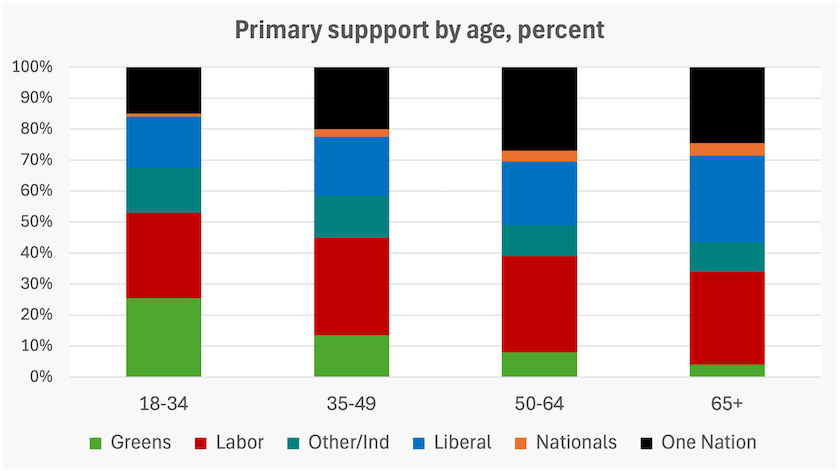
Demographics are not on the side of parties on the right. The Morgan poll also surveys voter support by gender, finding that men are much more attracted to One Nation than women are.
Parliamentary productivity
Who are the productive federal parliamentarians and who are the time wasters?
For decades the Productivity Commission and its predecessor bodies have been concerned with the productivity of our manufacturing, distribution and agricultural industries. More recently economists have been grappling with ways to measure productivity in labour-intensive service industries such as health care and aged care.
But how productive is our Federal Parliament?
The public interest group Amplify has gone about this task using stablished methods of work-study engineers. That is, they look at the way Members of the House of Representatives and Senators use their time, studying 625 hours of speaking time and more than 16 000 speeches. The most productive way to go about this task, of course, is to use artificial intelligence to undertake the slog work of reading all that material.
Their results are on a highly informative website, House Monitor, which for each MP, and for each party, classifies their activity according to five functions:
- Policy
- Political theatre
- Recognition
- Formalities
- Bad behaviour
A work-study engineer would see this first function, “policy”, as necessary and useful output. Recognition and formalities are aspects of any well-functioning workplaces. But bad behaviour is distinctly unproductive, and political theatre properly belongs to the entertainment industry, who do it far better than parliamentarians.
The results by party are shown below.
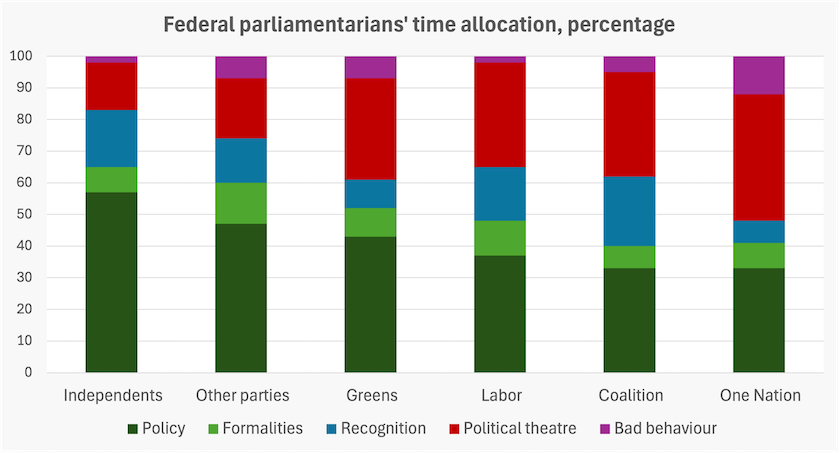
The poor showing by the Coalition (the survey predated the split) is clear. Labor’s performance, while a little better, is also disgraceful. Policy is surely the task of a party in government, and a party with a massive majority surely has no reason to engage in political theatre.
Amplify also has data, in graphical form, on the top ten individual Parliamentarians in three special categories.
- Among “policy leaders”, six of the top ten are independents (including Jacqui Lambi classified as “independent”), four are Labor;
- Among “political players” eight of the top ten are Labor, two are Coalition;
- Among the “worst behaved” are the Coalition’s Ted O’Brien, Alex Antic and Jacinta Price. Labor is not represented. The other seven are from minor parties in the Senate.
Inside the cabinet
How cabinet works in Australia: is it all too routinized?
Perhaps the silliest thing Tony Abbott did during his two years as prime minister was to recommend Prince Philip, the husband of the Queen of England, for a knighthood in the Order of Australia. As he said it was a “captain’s call”, and it contributed to his political downfall.
Had he put the idea to cabinet it probably wouldn’t have made first base: public servants preparing cabinet documents would probably have thought it was an April Fools’ joke.
But how does cabinet work? We know that it’s where executive government makes important decisions, particularly decisions that cut across portfolios, requiring the attention and agreement of different ministers.
To quote from the Cabinet Handbook, a 47-page set of directions relating to the workings of cabinet:
As a forum, the Cabinet seeks through discussion and consultation to resolve disputes and build consensus around often difficult and controversial issues. The decisions of the Cabinet are understood to be collective, not of individual ministers, and Cabinet solidarity requires all ministers to take responsibility for them and to support them.
There is no mention of cabinet in our Constitution, which means its specific ways of working can develop over time. These ways tend to be shaped by the prime minister. The current (fifteenth) edition of the Cabinet Handbook is signed off by Anthony Albanese and by former Attorney-General Mark Dreyfus.
Joe Walker has a podcast – Cabinet is Australia’s operating system: here’s how it works – in which he interviews two former heads of the Department of Prime Minister and Cabinet about cabinet’s operations. They are Terry Moran, who served in that role from 2008 to 2011, and Glyn Davis who served from 2022 to 2025. Both are highly respected for their behaviour as professional public servants.
A warning to readers: Joe Walker’s podcasts require commitment. He’s a skilled interlocutor, who keeps conversations on track in well-structured sequences. But his podcasts are long: this one runs for two-and-a-half hours. One for a wet Saturday afternoon, or a drive from Sydney to Canberra. Mercifully he includes a transcript.
Although it runs as an unbroken interview, it falls into two parts. The first, running for 100 minutes, is about the general workings of Cabinet. It’s the content of the handbook brought to life by two professionally disinterested people who have been at those meetings. The second part is on a different tack, for it gets onto issues about state capacity, the influence of Treasury, and the way state capacity has been eroded by privatization.
Part 1. The mechanical process
The first part describes a disciplined process, designed to smooth the work of cabinet. There are rules about interdepartmental consultation and coordination, rules about the way cabinet submissions are prepared, and rules about how they are recorded and publicised if necessary. It all confirms the aphorism that Australia has “a talent for bureaucracy”.
Walker and his guests see this as a positive aspect of Australian public administration. That’s an understandable view, coming from people who have had to ensure the process runs well, and who have observed enough of public administration worldwide to know the consequences when such discipline is absent.
Such is their enthusiasm, however, that they don’t discuss possible limitations of the process. It is designed to handle a large workflow – perhaps up to ten submissions a cabinet meeting – but has it all become too routine? Does the emphasis on consultation and coordination mean that creative or left-field ideas don’t show up as options presented to cabinet? Does it have a bias towards incremental policy adjustment, and away from more far-reaching reforms? Does it have a risk-averse bias? Is its flexibility constrained by its paper-based formats?
These questions are particularly relevant in relation to the present government which is notably cautious in its administrative style.
Part 2. Treasury’s dead hand
In the second part of the podcast – starting around 1 hour 40 minutes – is a discussion about state capacity. There is an acknowledgement that privatization has diminished the Commonwealth’s capacity to respond to people’s needs. This is not some retrospective criticism of austerity programs run by previous Coalition governments: the whole discussion is non-partisan. Rather, it’s about what some may call the “Treasury line” in cabinet submissions – a preference for privatization and contracting-out over service provision, and pressure to cut public service numbers.
It’s a strong point, and these aren’t the first close observers to make it. In Treasury there are hints of a culture that sees itself as representing “the permanent will of the people” to quote an old saying. Spendthrift governments will come and go, but there will always be Treasury with an ongoing responsibility to ensure that they contain their enthusiasm for spending. Perhaps a government – probably a Labor government – will have some new program: it’s better that it be contracted out rather than delivered by the public service, because it’s easier for a subsequent government to cut privatized programs rather than to abolish government agencies.
Nowhere is this written, but there are hints of that culture in the Cabinet Handbook, which makes several references to the need for cabinet to consider the financial consequences of its decisions. That’s understandable. But the handbook is remarkably quiet on any responsibility for cabinet to consider the broader economic consequences of its decisions. Major capital works involving large outlays would be accompanied by cost-benefit assessments, but for smaller projects, and for programs that involve resource re-allocation without government financial outlays (for example regulatory measures), there is no requirement for a cost-benefit assessment. It’s the dominance of fiscal management over economic management, and the idea of Treasury as the guardians of the people’s money – its “treasure”.
The rest of government
An observer unfamiliar with the institutions of democratic government would believe that the discussion is about the sole body that makes and refines policies – Australia’s “operating system” to quote the title. There’s hardly a mention of Parliament or its many policy-related committees. Hardly a mention of statutory authorities with delegated authority. Hardly a mention of Parliamentary processes that amend bills. Hardly a mention of the courts, or the Constitution.
That perspective, centred on executive government, is not surprising: it’s implied in the duty statements of senior public servants. But it’s a limited perspective that overlooks the primacy of Parliament.