Education
University governance
University administrators have been in the news lately, and it’s not good news.
Governance problems at ANU, which have resulted in the resignation of the vice-chancellor, and calls for the resignation of the chancellor, have been aired on national media, including the ABC’s 730.

ANU concourse
ANU’s problems probably command more than their share of attention because of the university’s location, and its close relationship with national institutions, but the problems are more widespread. Governance and administrative problems in our universities led the Senate, in January this year, to establish an inquiry into the quality of governance at Australian higher education providers. Cut short by the election, that inquiry didn’t get far, but in its interim report presented in April it referred to issues in the submissions it had received. Listed in the report these are:
- corporatisation of universities, including the influence of private sector consultants on university councils, and a decrease in the number of elected staff and student council members;
- centralisation of decision-making within universities, and the exclusion of staff and students from university decision-making processes;
- a lack of accountability and transparency around university decision-making (including council appointment processes) and failures to appropriately manage conflicts of interest;
- growth in the remuneration of vice-chancellors, as well as the number and remuneration of other senior executives (who may have limited academic experience);
- systemic and sector-wide non-compliance with workplace laws;
- high levels of insecure work, increased workloads, reduced academic autonomy, reduced course quality, and poorer student experiences;
- the appropriateness of TEQSA's [Tertiary Education Quality and Standards Agency] powers and opportunities to enhance their effectiveness, as well as other regulatory changes related to improving the quality of governance at Australian higher education providers.
After the election the committee was re-constituted, and it picked up where it had left off. It has produced another interim report, “that focuses on the accountability and transparency of decision making within universities, remuneration of vice-chancellors and other senior executives, and the appropriateness of TEQSA's powers”. This report has 12 recommendations relating to accountability, the way universities handle change, involvement of staff and students in decision-making, remuneration of university managers, and the use of consultants.
The committee in its ongoing work will give attention to the broader issues raised in its earlier hearings.
Senate committee reports don’t make easy bedtime reading, but in a 5-minute clip on Radio National Senator Tony Sheldon, chair of the committee as it was first established, summarises its findings and recommendations, referring to a “consequence-free rotten culture” that has infected our university administrations. He draws attention to one of the most outstanding figures in the report:
Whilst the committee accepts the importance of universities being able to remain competitive for global talent, the overwhelming volume of evidence received was strongly of the view that universities paying over 300 executives across the country more than the premier or chief ministers of their state was excessive, and out of step with community expectations of public institutions and international comparisons.
ABC education reporter Conor Duffy also has a post summarizing the report, with quotes from Sheldon and other commentators. The spirit of those comments is captured in a quote from Senator Marielle Smith: “Universities are public institutions, established for the public good. Their governance arrangements, and the remuneration of their senior executives, should reflect that”.
Anyone who has been involved with universities over a long period will have noticed the slowly-growing load of a managerial bureaucracy. Initially the growth was in the number of administrators, but that was followed by higher pay for all senior administrators, from the vice-chancellor down the line. The administrative culture was becoming increasingly separated from the academic culture. The administrative culture was rooted in managerialism in its worst aspects – extrinsic rewards, attention to a small range of specific performance metrics, rigid lines of positional authority, competition for personal and corporate resources, and a consideration of academic staff as costly and fungible resources. The academic culture has older roots that predate Weberian bureaucratic models and the cult of modern managerialism by many centuries. They are to do with the intrinsic rewards of scholarship, the opportunity to share and spread knowledge, and obligations to teach the young.
The committee’s recommendations include a cap on vice-chancellor salaries, and other requirements on managers, but even if they are implemented they could still fall short of bringing forth the changes that are required to bring universities together in one culture that serves the public interest.
Bill Shorten on universities
Bill Shorten puts forward ideas for university reform. Universities can be the nation’s “secret ingredient for economic sophistication and resilience”.
Just back from a visit to Kyiv, where he had been invited by a Ukrainian think tank, Bill Shorten delivered his speech to the Australian Institution of International Affairs about his idea for Australian universities in a world of escalating strategic competition, where “economic resilience is a core pillar of national security”.
Shorten became Vice-Chancellor of the University of Canberra earlier this year, an appointment he has taken to with an enthusiasm that would be seen as too assertive for a politician. He’s clearly enjoying his new role in public life.
He puts forward three suggestions.
First is the creation of a stream of specialist universities. “Such institutions would concentrate our finite research funding and talent, creating genuine, world-leading centres of excellence, rather than dozens of competing, under-resourced departments.”
Second is the creation of universities that demand and reward excellent teaching. The University of Canberra in its earlier years, like other Colleges of Advanced Education that morphed into universities, saw teaching as its main purpose. But over time, under pressure to meet targets for published research, staff were to come under pressure to compromise teaching standards to make time for these additional demands.
Third he reminds us, once again, of “the gaping chasm between Australia’s excellent discovery research and our ability to apply and commercialise it”.
A 4-minute session on Radio National in which he presents his ideas is titled Shorten calls for radical universities shakeup, but there is nothing radical or even novel in these suggestions. Rather the problem seems to be that our universities are nervous about exhibiting anything more than minor variations around a standard model, with the three-year degree at its core.
Education pathways after high school
Longitudinal census data shows that those whose high school years are in state schools, particularly boys, make slow progress in further education and skills accumulation.
How do our choice of high school set us up for further studies, the development of skills, and employment in meaningful occupations? Do boys and girls have different post-school development paths?
David McCloskey of the Australian Population Research Institute addresses these questions and publishes his findings in a research report: School choice and careers – occupation profiles in 2021 of males and females who attended Government, Catholic and Other Independent secondary schools in 2011. His research is enabled by the ABS’s publication of linked returns from its five-year censuses.
His broad findings are that ten years after their high school years, girls have done better than boys, and that those who were in independent and Catholic schools have done better than those who were in state schools. His paper provides detailed tables, the main one of which can be summarized graphically.
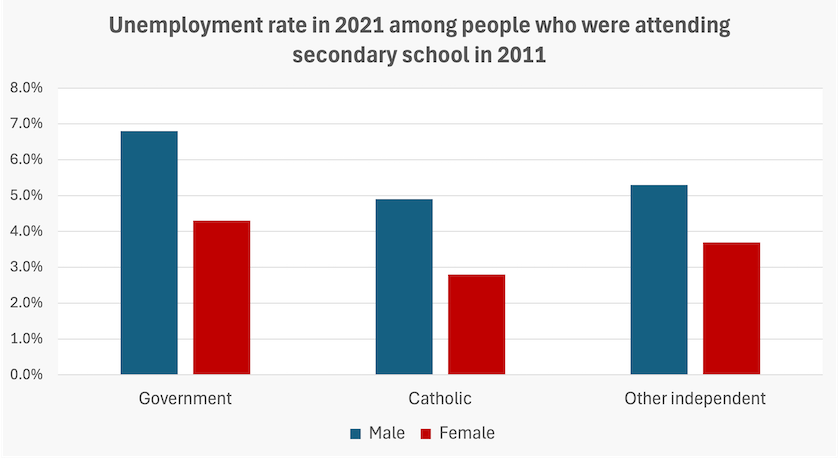
The first shows differences in unemployment rates in 2021. The differences are clear.
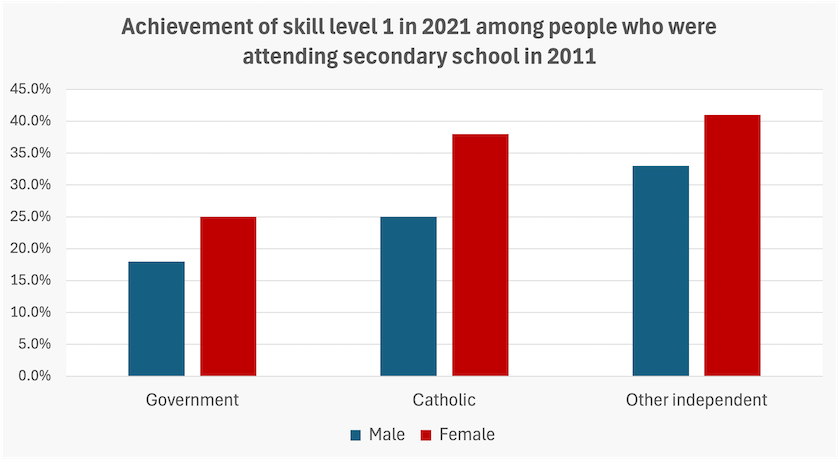
He also looks at people’s attainment of skills, using the ABS classification of five skill levels. The graph below is of people’s attainment of skill level 1 – “Jobs which require at least five years relevant experience or a bachelor’s degree or higher qualification”. By this metric “other independent” schools have an edge over Catholic schools, but both are well ahead of government schools.
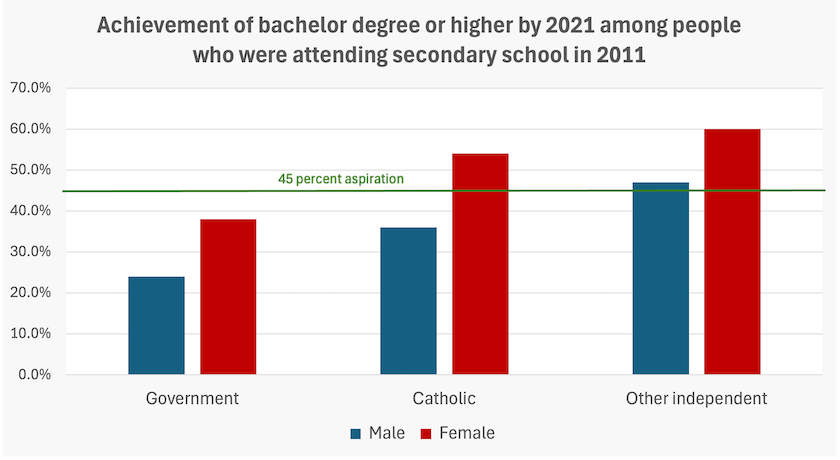
He then compares the results with a goal, based on Jobs and Skills Australia research, which indicates that by the middle of this century 45 percent of all 25 to 34 years olds will require tertiary education. On this goal the gender gaps are stark, as are the comparisons with government schools. The only boys who have so far met the 45 percent target are those who were at “other independent” schools.
He analyses the same data by state. There is particularly strong variation by state among people who attended government schools, as shown in the following graph.
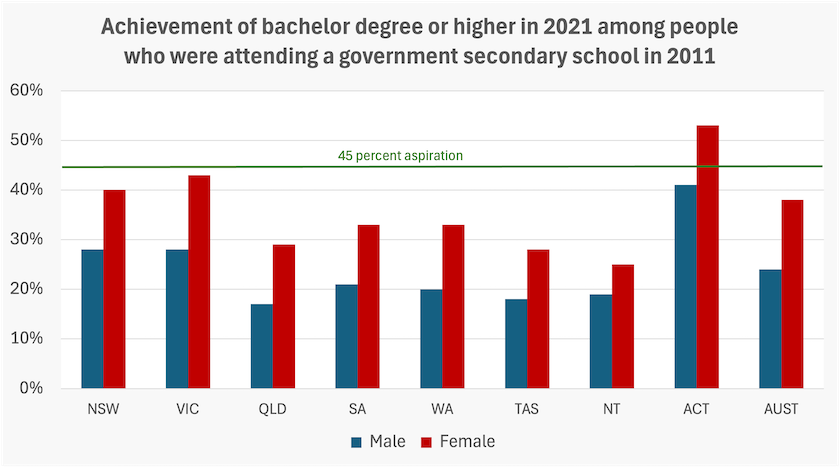
These differences between states leads him to analyse the data in more detail, and he notes particularly the high rate of graduation with medical degrees among those who attended New South Wales government schools. He speculates that this may reflect that state having 47 selective entry schools.
His analysis goes on to look at occupation by industry, focussing on gender differences. Young women who attended other independent schools are heavily represented in professional service industries, particularly health care.
The differences revealed in his analysis are strong. His analysis does not reveal causal factors, but some are suggested in his summary, where he poses four questions:
- Is fiscal equalisation (equality of investment inputs) through the Grants Commission working as intended?
- Why do the current funding formulas for secondary school education deliver such unequal outcomes?
- What is the role of school culture and teaching methods in building engagement with post compulsory education?
- What “compensation” or targeted interventions can school systems offer to students coming from families with little experience of post compulsory education?
These lead him to put forward three hypotheses:
- Difficulties in thriving in early education may reduce engagement with education and interest in pursuing education beyond compulsory schooling.
- School culture and teaching styles may be critical in building and maintaining engagement in education. The performance of selective entry secondary schools in NSW indicates that an expansion of selective-entry schools in other states and territories may help to close the gap.
- School culture and ethics may play a role in the choice of careers taken up by former students. In particular the Catholic sector produces significantly more women working in “caring” and health professions including midwifery, speech pathology and audiology, psychology, podiatry, special education teaching, nursing, early childhood teaching, counselling and work as nurse managers.
His analysis describes an education system that is collapsing. Those who have the means have taken their children out of government schools. Some others, particularly in New South Wales, have been able to find places for their children in selective high schools. The result is a weakened government school system, on the way to becoming a residual service for the poor or the “indigent” to use the American term. The implications for social mobility, and realization of our nation’s capabilities, are grim.