Economics
Climate change – a busy week in public policy
A report and a commitment: our policymakers are becoming focussed on several aspects of climate change.

Quite apart from the fuss about the Coalition parties’ conflicts over 2050 emissions targets, there have been serious policy developments on climate change.
On Monday the Australian Climate Service released Australia’s first Climate Risk Assessment, covering risks imposed on all our life-support systems by global climate change. It details risks to communities, to defence and other aspects of national security, to health and social support systems, to infrastructure, to food production and other farming, and to our natural environment.
Then on Thursday the government announced the country’s 2035 climate change target, which involves a 62 to 70 percent reduction on 2005 emissions. That announcement covered a package of supporting policy documents:
A set of sector plans – electricity and energy, agriculture and land, the built environment, industry (mainly manufacturing), resources, and transport – in a document The Net Zero Plan and six supporting sector plans. Unsurprisingly much of the task is to fall to electricity generators and users.
Treasury’s economic modelling, which emphasises the economic benefits of a well-implemented plan to reduce emissions. It comes as close as Treasury might ever come to endorsing a strong industry policy, by warning about the risks and costs of a “disorderly” transition.
The Climate Change Authority’s advice, on which the policy is developed, detailing how we should move from our 2030 target of a 43 percent reduction to the 62 to 70 percent reduction by 2035. Meeting both targets will require a considerable acceleration of our present process.
A document about our national contribution towards reducing emissions, with reference to the 2016 Paris Agreement and other international agreements.
The announcements also include commitments to provide $7 billion for the National Reconstruction Fund and the Clean Energy Finance Corporation, as well as $1.3 billion for specific projects.
There has been a flood of initial comment, some partisan (e.g. the Coalition’s “economy wrecking” statement), some strategic (environmental organizations calling for deeper cuts), and much that is only partially informed. Among energy experts are Conversation comments by Tony Wood of the Grattan Institute – The Albanese government has finally set a 2035 climate course – and it’s a mission Australia must accept – and Rod Sims now of the University of Melbourne – Cut emissions 70% by 2035? There’s only one policy that can get us there. Sims’ “one policy” is a carbon price. The ABC’s Jo Lauder has assembled the views of a number of experts in an informative post: Australia's 2035 climate targets on path to net zero judged by the experts.
Over the next few weeks there will be much more comment about this target. Some already see it as inadequate, particularly in relation to more ambitious targets (up to 75 percent) that were being talked about when the US government had a strong climate change policy. Others will claim that it is too ambitious, or unaffordable.
We should watch the language in these statements. Spokespeople for the fossil fuel industry, and partisan politicians with a visceral hatred of renewable energy, will talk about the “cost” of reducing emissions, while government and renewable industry spokespeople will talk about “investment” in our industry transformation.
There is a risk of a great deal of confusion in these public arguments, because there are four overlapping but separate issues:
- The effect on Australia of global emissions – the subject of Monday’s report. Our response has to be reactive and defensive, for example by shifting populations and zones of agricultural production. It’s not a matter of ideology, except to the extent that we believe we should collectively compensate our people for adverse events caused by the world’s decision-makers who have gone on burning fossil fuels to contribute to these events.
- Our contribution to global emissions resulting from our own energy use. That’s the main subject of Thursday’s announcements and reports. Expect the argument that because we contribute only something like 1.3 percent of global greenhouse emissions, there’s not much point in our doing anything – an argument so morally empty that it’s not worth rebutting.
- Our contribution to global emissions resulting from others’ use of the coal and gas we export. This has been a major point in relation to the approval of Woodside’s North West Shelf gas project through to 2070 – 20 years after we are supposed to achieve net zero. The standard defence is the drug dealer’s defence – if I don’t supply the market someone else with fewer moral scruples will take my place.
- Our energy transformation. Even if coal and oil were not contributing to climate change, there would be a good case to reduce our dependence on them, because they are sources of local pollution, are becoming more expensive to extract, and the geopolitics of the oil industry are rather ugly. Our geography and the tumbling cost of renewable energy generation and storage give us an excellent opportunity to become a low-cost supplier in a competitive market for energy-intensive products.
Has the government gone cold on superannuation tax reform?
Higher taxes on earnings from $3 million-plus super balances probably remain on the table, but they are subject to re-design. The government is still ducking the need to tax income from super funds in retirement phase in the same way as other income is taxed.
Even though supporting legislation has not been enacted, the Australian Taxation Office has already announced that as from this financial year earnings from superannuation funds with balances above $3 million will be taxed at 30 percent, an increase from the 15 percent already applying.
The Treasury estimates that it will apply to only a small number of people:
The additional tax on earnings imposed by this measure will impact around 80,000 individuals in 2025–26, or approximately 0.5 per cent of individuals with a superannuation account.
This is essentially unfinished business from the government’s last term in office. Before the election the bill to enact the change had been stuck in the Senate in one of those unholy Green-Coalition deals.
In spite of misinformation about its effects on people’s superannuation, it has public support. William Bowe’s Poll Bludger reports on polling by Demos, conducted in late July, revealing that 45 percent of respondents supported the move, while 33 percent were opposed. That same survey also found strong partisan alignment around the plan to increase the tax on earnings from high balances: 59 percent of Labor voters but only 33 percent of Coalition voters supported it. Support was lowest among One Nation voters – 28 percent – although they are probably least likely of all voting groups to have to worry about handling $3 million superannuation accounts. This possibly indicates the effectiveness of scare campaigns directed at uninformed voters.
Because it would be easy to re-present the bill to Parliament some observers are wondering why it has not been legislated. Has the government got cold feet? Have they been put off by a strong campaign by Tim Wilson, Liberal Member for Goldstein? If so its delay bodes poorly for more substantial proposals for tax reform emerging in the wake of the recent roundtable.
A more likely explanation is that, as with the 2019 election proposal to abolish franking credits, Labor didn’t run this proposal across a few suburban accountants who could have spotted its administrative complexities and unintended consequences. Writing in The Conversation Natalie Peng of the University of Queensland suggests that the government is taking the reforms back to the drawing board, and she suggests how a re-design might work, without undermining its original intent of making the tax system fairer and more neutral in its treatment of income from idle investment and income from work.
She explains that one objection to the bill is the lack of indexation of the $3 million because the time will come when $3 million is not a large amount in real terms. But that’s a problem for a distant future, and if the recent past is any guide there will be many changes to superannuation legislation before the median superannuation balance – $60 000 in 2022-23 – comes anywhere near $3 million.
The more substantial problem is that the 30 percent tax is to apply to all earnings, even though some of those earnings are gains in the book value of the funds’ investments. That’s an accounting concept of earnings, but as the proposals’ opponents point out, it could result in people having liquidity problems. If, for example, your superannuation fund had bought shares in companies paying few of no dividends, but which were appreciating strongly in value, they may show an impressive accounting profit, but without providing enough cash to pay the tax bill.
Peng’s article suggests ways the proposal could be amended – to tax only realized gains, for example, or to use deeming rates as is done with pensioners’ asset tests.
The point conveniently overlooked by the proposal’s opponents is that the purpose of superannuation is to provide an income – a cash income to meet retirees’ day-to-day expenses. If one’s superannuation is locked into illiquid investments it would surely be failing what is known as the “sole purpose” test – that is, provision of a cash income in retirement. What Wilson and his colleagues seem to be arguing for is the notion that superannuation should be used as a means to accumulate financial wealth to pass on to children.
That is not how our superannuation system was designed, Peng reminds us:
The superannuation system was designed to provide retirement income, not to serve as a tax-free inheritance vehicle or wealth shelter. Extremely large balances stretch that purpose and risk undermining public trust.
Some opponents of the government’s proposals refer to the way the $3 million threshold and the tax on unrealized gains could apply to farms. That’s fair comment to a certain extent, because the market price of most farms is usually well above their economic value, and annual revaluation would be expensive. But why do people put their farms into their superannuation accounts – unless they are using superannuation as a tax dodge? In view of the poor and volatile returns from farming, it does not seem to be a wise investment for a superannuation fund.
If the opponents of taxing unrealized capital gains (or realized gains) want to make a more valid objection they could point out that a portion of the increase in asset values relates to inflation. Until 2000 capital gains tax applied only to real (inflation-adjusted) capital gains. But the Howard government abolished indexation, and replaced it with an arbitrary 50 percent discount. That arrangement was designed to favour a fast turnover of assets – the activity of stock market and real estate speculators – but it is punishing on long-life assets, such as a share portfolio built up over 45 working years, or equity in a small business. Here is a case opponents to the government’s plans could make about the treatment of capital gains, but it seems that they are reluctant to criticize anything the Howard government did.
As for the government, it is still largely ignoring the broader issue of unfair tax advantages applying to retirees with large superannuation balances. There is a solid argument in tax equity that the earnings (not the drawings) of superannuation funds should be taxed at the same rates as are applied to the earnings of those who work for a living, and at the same rates as are applied to those who have accumulated savings outside the superannuation system.
As an example of the inequity consider someone with $2 million invested in superannuation, enjoying a real return of 5 percent. That person’s $100 000 income (almost four times the single pension) pays no income tax, while a worker earning $100 000 would be paying $20 000 a year in tax.
There is a much stronger case for abolishing all tax concessions for superannuation in their retirement phase, than for fiddling with very large balances.
Sussan Ley on fiscal policy
Sussan Ley’s speech to CEDA avoided difficult questions about the Coalition’s economic policy, but its tone was calmer than that of her predecessors.
The media, including the ABC, are calling Sussan Ley’s speech to the Committee for Economic Development Australia “her first major speech on the economy”.
In fact it’s about the much narrower topic of fiscal management: there is virtually nothing in her speech about the economic policies a Coalition government would pursue. There’s no mention of energy policy, trade policy, industry policy, housing policy, immigration policy – the set of policies that shape our nation’s economic structure.
It’s quite understandable that Ley has avoided any mention of economic structure, because as we have seen, any mention of energy policy or immigration policy sets off an ideological shitstorm between the Coalition’s factions, providing opportunities for those who want to undermine her political authority and drive the Coalition’s policies to the extreme right. The policy differences between the National and Liberal parties, and within the Liberal Party – a party that has lost touch with its historical base – are irreconcilable.
So Ley has stuck to the safe ground of accusing the Labor Party of fiscal profligacy, and has reverted to the standard tropes about containing government spending, the customary Liberal Party messages about encouraging “personal responsibility and reward for effort”, and so on.
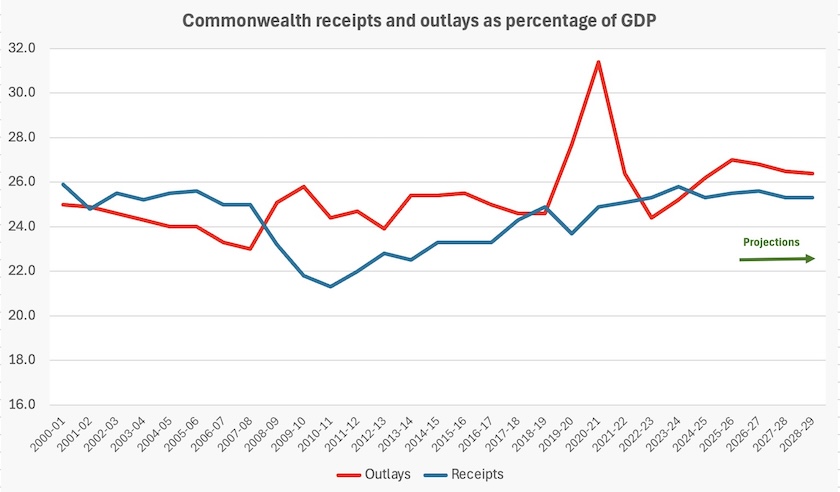
In case anyone is convinced by her assertions that the Albanese government is on a reckless path of big spending, the fiscal reality is far less exciting. The present government is pursuing a conservative fiscal policy, with deficits between 1 and 2 percent of GDP, and is dealing with the debt accumulated during the Covid pandemic. In comparison with most other “developed” countries Australia stands out as an exemplar of fiscal conservatism. The USA, for example, is running a fiscal deficit of almost 6 percent of GDP. The UK’s deficit is close to 5 percent of GDP, and even Germany’s deficit is almost 3 percent of GDP. Our rather boring fiscal story is shown on the graph below.
One could go on picking inaccuracies and misrepresentations in her speech, but it’s a standard Australian political presentation – one wouldn’t expect to find anything different.
In fact in comparison with the strident tone of Liberal Party prime ministers and opposition leaders in recent years, the tone of Ley’s speech is remarkably calm and it even has some valid economic arguments. She acknowledges that government has a productive role in the economy, she recognises the importance of Medicare and publicly-funded education, and she mentions the need for governments to be involved in providing infrastructure. This is in contrast with her predecessors’ tendency to present government as some large and intrinsically wasteful unproductive overhead (a line still pursued by Angus Taylor).
But she still asserts that government spending, and therefore taxation, must be capped:
We would have a clear handbrake on the amount of tax collected.
Unlike some Liberal politicians, who often committed to a taxation limit of 23.8 percent of GDP (a number strange for its precision), she avoids specifying a limit, but she is critical of the government for having let spending reach 27 percent of GDP.
The hard reality, avoided by both the government and the opposition, is that we are not collecting enough tax to fund necessary public services and social security transfers. As is regularly reported in these roundups, Australia has almost the lowest taxes of all high-income “developed” countries. We have muddled through with costly privatizations (electricity infrastructure, private health insurance, toll roads …) and savage cuts to tertiary education, public housing and spending on physical infrastructure.
This “small government” obsession has weakened our economy, and we are not facing up to demands for increased defence spending, the demands placed by an ageing population, and the fact that human services provided by governments are necessarily costly and labour-intensive. It’s all very well for an opposition leader to promise that there will be no cuts to necessary public services while revenue is contained, but that’s mathematically not possible.
Ley mentions a few instances of government waste: they’re always easy to find. Maybe, as she suggests, the government could do better on containing NDIS spending, but the government is already working on that. She hints that more means-testing could be applied to some government programs, but that carries the problem that government services could become residual and impoverished provisions for the “indigent”.
In her speech however, there is a hint of where more public revenue could be found. She refers to research by the Centre for Independent Studies showing just 10 percent of taxpayers pay two-thirds of all income tax. The CIS data may be overstated, but it is clear that our taxes, particularly our income taxes, are collected from too small a base. The people who are not pulling their weight include “self-funded” retirees, property speculators and small businesspeople who use family trusts to avoid tax.
Maybe those rorts weren’t in her speechwriter’s mind when he or she wrote that part: they are all traceable to decisions by Coalition governments. But they would be good places to fill our need for more public revenue.
How well is Australia travelling?
The government has re-started a set of time series on wellbeing. They paint a complex picture of Australia’s progress.
With little fanfare, on Monday the ABS released what it calls an update to its Measuring What Matters data – “a wellbeing framework that tracks our progress towards a more healthy, secure, sustainable, cohesive and prosperous Australia”.
It’s a set of time series of wellbeing indicators – 50 in the current iteration, clustered around those five headings.
If you want to use this data to get a single indicator about how well Australia is travelling, you’ll be disappointed, because it does not try to consolidate these 50 indicators into one or even a small number of key indicators. We all differ in what we see as indicators of wellbeing. It’s up to the reader to apply his or her weights.
We can use our judgement to make some assessment of our progress towards a better or worse life. Most people would consider that the indicators on social cohesion are negative. Our “sense of belonging” has fallen, as has our “trust in others”, and we are more inclined to “feel very lonely”. Some of our health indicators could look worrying: for example the prevalence of chronic diseases has risen over the last 15 years, but is this simply a consequence of ageing?
Jenny Gordon of ANU has a Conversation article focussing on what she sees as negative trends in the nation’s health revealed in this data. The Centre for Policy Development has a post on Measuring What Matters, generally focussing on what it sees as negative indicators. There are more headlines in the negatives than in the positives.
In most areas the data presents a mixture of indicators. If you look at security indicators you will see a downward trend in “experience of violence”, but there is also a recent downward movement in the percentage of people who feel safe walking alone at night.
One thing that stands out is the steadiness of most indicators. There is a set of economic indicators under the “prosperity” heading, and while they show some negative trends, such as a decline in productivity and a fall in the proportion of young people engaged in study, there is nothing in them that points to a “crisis”. In particular there is no evidence of a “cost of living” crisis.
That’s an important point, because a crisis, such as a pandemic, calls for an immediate policy response. But a drawn-out deterioration in indicators calls for structural change, rather than short-term measures such as temporary tax cuts.
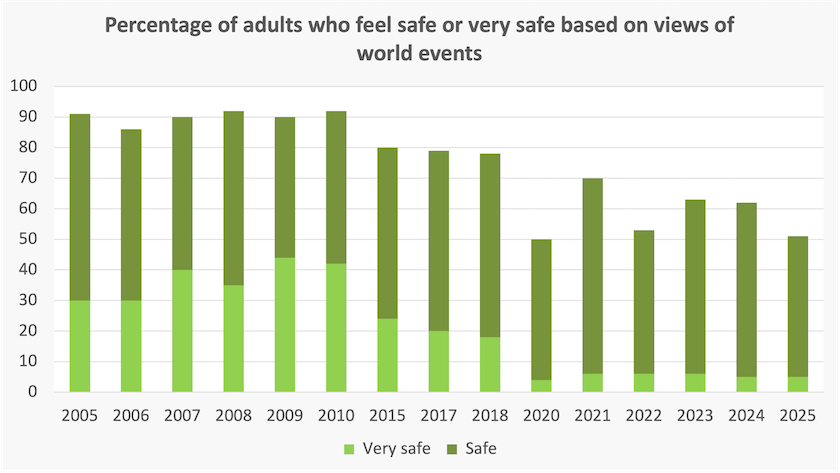
One of the few indicators that does show a dramatic deterioration relates to people’s concerns about the influence of world events. We feel much less safe than we did ten years ago.
If you browse through these indicators you may be disappointed to find that many have only a few data points, and that some have only one data point, which means they tell us nothing about progress. That’s a function of the history of this project, because it has had a stop-start life.
The ABS has a long history of social indicators, going back to 1976, but in those earlier days they were seen as a somewhat separate service from their well-established set of economic indicators. In reality, however, all of the ABS’s work is about social indicators: the only point in collecting data about the unemployment rate and the GDP is because they say something about our wellbeing.
That conceptual separation slowly disappeared, and in 2002 the ABS pulled together “social” and “economic” data in a series known as “Measures of Australia’s Progress”, which got a financial boost in 2011 from the Gillard government. It was groundbreaking territory for the ABS: collecting data is their everyday work, but pulling it together in a form that helps people interpret it involves going outside statisticians’ familiar territory. There is little ambiguity in counting the number of people in Parramatta on census night, in analysing figures on road fatalities, and so on. But some questions, such as those on financial security, are about how people feel.
The choice and framing of questions on people’s feelings and attitudes takes statisticians close to the possibility that they are conveying their own values of what is positive and what is negative, but the statistician is supposed to be a disinterested observer. The ABS put considerable resources into dealing with these basic policy issues, and in doing so gained expertise which was recognized world-wide.
MAP was just getting up to speed when in 2013 the Abbott government pulled its funding, which is why the series stops in that year. The Abbott government saw MAP as a waste of money: what’s the point of gathering data when you have no need for evidence because you know instinctively what’s best for the country?
MAP is archived on the ABS website, with its 2013 data and several pages of explanation about the project.
A promise of the Labor Party in the 2022 election was to develop a set of wellbeing indicators, a task it assigned to Treasury, who included a chapter in Budget Paper 1 titled “Measuring what matters” (on pages 119 to142). The second iteration was a stand-alone paper published by Treasury in 2023.
In the roundup of 29 July 2023 there is a set of links to the 2022 and 2023 reports, along with some analysis and comment. The 2022 effort was hastily put together, and it shows. The 2023 update was more comprehensive, but it was still a Treasury document, produced by people who are able and well-qualified, but who have difficulty with numbers that don’t have a dollar sign in front of them.
So in 2024 the project came back to the ABS, and the government has promised to support it with a $15 million appropriation over five years. The government and the ABS are expecting the number of indicators to increase over the coming years, and the longer it goes on the more reliable will be the time series it generates.