Public ideas
The right’s attraction to Putin’s Russia
Anne Applebaum explains why the far right is attracted to Putin’s Russia.
In the middle years of last century, many of the left in western countries, including Australia, saw the Soviet Union in the way its crude propaganda presented itself as a workers’ paradise.
Seventy years on, it’s people on the far right who idealize Putin’s Russia.
Dominik Presl of Prague’s Station Zero interviews The Atlantic’s Anne Applebaum to explain this attraction: Why do MAGA Republicans hate Europe so much?, in a ten-minute clip from a longer podcast. Presl wonders whether the right’s affection for Putin’s Russia is a passing Trump phenomenon, or if it is something deeper.
It’s not only about Trump. Applebaum explains this “strange and eerie parallel” in much the same way as she explains the left’s attraction of times past. The far right is attracted by an image of a “white” Christian country, that upholds family values, and rejects the woke culture that has infected the west. As Applebaum explains this is no more a description of Russia than the workers’ paradise was in past times, but it’s the image that counts, and Putin has been very skilled in projecting that image.
Lest we think this is a purely American phenomenon we should remind ourselves that Tony Abbott and some of his colleagues have been closely involved with Hungary’s Danube Institute, funded by that country’s Moscow-aligned strongman Viktor Orbán. And it would be naïve to believe that the anti-renewable energy lobby in Australia is a purely home-grown movement. Russia has much to lose if a medium-sized country can demonstrate to the world that it’s possible to make an affordable transition away from fossil fuels, giving it a strong incentive to support the anti-renewable lobby in Australia.
And we should not overlook the attraction of the “strong leader”, which Putin projects in a way that Anthony Albanese and Sussan Ley don’t. The task of leadership in a democracy is a slow and patient process, often proceeding quietly away from the public eye, and has little in common with the strongman’s braggadocio.
Rumours of the death of neoliberalism are greatly exaggerated
The populist right reinterprets neoliberalism, exposing even more dysfunctional ideas.
A half-century ago political parties on the right, most notably Republicans led by Ronald Reagan and Conservatives led by Margaret Thatcher embraced neoliberalism with enthusiasm.
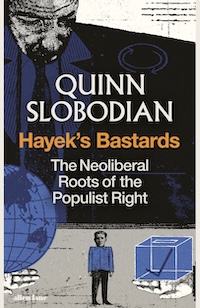
In more recent times, however, those same parties have turned against neoliberalism and towards populist politics that reject the laissez-faire of neoliberalism, and the ideas of globalization, turning to anti-market policies of isolationism and protectionism. Nowhere is this more evident than in Trump’s America. We see it in Australia too, where the Liberal Party has drifted further and further away from market-based policies.
Christopher Pollard of Deakin University, writing in Open Forum – Hijacking Hayek – reviews a book by Quinn Slobodian, Hayek’s bastards: the neoliberal roots of the populist right, which rejects the above interpretation of political history. To quote Pollard:
He [Slobodian] challenges prominent narratives that describe populism and the alt-right in terms of a “backlash” against the forces of neoliberalism. The key figures in Hayek’s Bastards are not presented as “barbarians at the gates of neoliberal globalism but the bastard offspring of that line of thought itself”.
Slobodian argues that this new generation of neoliberals shifted away from purely economic issues, to find deeper ground for their ideas that might justify the notion that egalitarian politics and the social state are in conflict with human nature.
Based on such an (untestable) theory, they have been able to rationalize their rejection of democracy, and acceptance of the idea that there are “race differences in cognitive capacity”.
That seems to give Trumpism, and movements such as Alternative für Deutschland and Nigel Farage’s Reform a consistent but badly flawed and weak framework for their ideas.