Economics
We’re neglecting our most important assets – universities
In America and Australia there has been an assault on higher education and on learning generally. In America it is blatant; here it is longer term and more unnoticed.
There are two ways governments can degrade the Enlightenment idea of valuing learning – directly and indirectly.
Trump has chosen the direct way, exemplified by his assault on Columbia University. Using the 1964 Civil Rights Act, which prohibits spending public funds on institutions that discriminate on the basis of “race, color, and national origin”, his administration withdrew federal funding from Columbia, on the basis that the university has allegedly failed to squelch antisemitism on campus. As part of the settlement to have funding restored, Columbia has agreed to pay the government a fine of $US221 million, adopt a federally-endorsed definition of antisemitism, roll back diversity, equity and inclusion programs, review its Middle East curriculum, and introduce new vetting measures for international students. As Franklin Foer writes in The Atlantic, Columbia protected its funding and sacrificed its freedom, in a settlement that “bodes ill for American higher education”.
Trump has also been threatening Harvard, which receives more than $US2 billion in federal funding, with a similar move. Harvard has so far resisted.
Writing in the Harvard Magazine – This is how universities die – Wiilliam C Kirby explains what happened in other countries, including Germany and China, when governments stepped in to dictate what universities do. He writes:
Fortunately, the United States is not (yet) Berlin in 1933 or Beijing in 1950. It retains an independent judiciary and rule of law, and it has, in Harvard, a university with the history, will, and resources to resist. In its resistance, Harvard has reaffirmed its leadership in American higher education as nothing else could. Should it fail, we shall witness the destruction of the one industry, higher education, in which this country is still number one. We shall destroy our capacity to recruit talent from all shores. We will decline. For history shows that universities can die, and nations will decay.

Memorial Hall, Harvard. Note the defensive parapets.
The irony of these antisemitism charges is that American universities offered refuge to Jews fleeing Europe during the Nazi era, and American Jews are represented strongly in the faculties of American universities. With their acute awareness of the way populist authoritarianism can destroy democracy and establish brutal regimes, Jews in American universities have generally been a strong voice for liberalism.
The suggestion that Trump’s moves have anything to do with antisemitism is rubbish. American students, like students in other liberal democracies including Australia, have been demonstrating against the brutality of the Netanyahu government, and have been expressing sympathy with the long-suffering Palestinians in Gaza and the West Bank. A few have let these feelings extend to hostility to Jews on campus, which goes against the whole principle of academic freedom, but universities have always had means to deal with such behaviour. And no doubt some students, naive about Hamas, have been expressing sympathy for it, even though it is a violent, far-right, misogynistic, theocratic, authoritarian movement, unlikely to have much appeal to undergraduates. They will learn.
That’s not surprising or worrying: young people experiment with ideas, and a university provides the protective environment where people can study the appeal of extremism. If they study extremism deeply enough it soon loses its appeal. Successive American governments’ failure to understand the attraction of extreme political movements has led it into costly foreign policy disasters.
Australians may smugly claim that such an assault on universities would never happen here, but it has been happening for some time, although far less blatantly.
We achieve our assault on Enlightenment values through funding, in a slow war of attrition that goes back to 1986, when the Hawke- Keating government introduced the Higher Education Administration Charge. It was $250 at the time – about $800 in today’s terms.
Up to that point, explains Bruce Chapman, universities had been free for almost all students: until 1973 around 75 percent of students had Commonwealth or teachers’ scholarships, and from 1973 to 1986 universities were free. Senior managers in Treasury, now approaching retirement age, would be among the last cohort to have enjoyed free university education.
Australian students now have among the highest student fees for bachelors’ degrees out of high-income OECD countries (only Canada and the US have higher fees), and the second highest fees for masters’ degrees (only the US has higher fees). This has come about partly through funding creep, the initial $250 having been the thin end of the wedge.
This results mainly from the obsession with government debt, as if there is something wrong with government debt that isn’t wrong with private debt. Governments, concerned with their own debt, saw no problem or contradiction in shifting debt from their own books on to students and graduates. The other reason is that politicians, including Labor politicians, saw tertiary education in terms of distributive welfare, rather than in terms of national investment in human capital. Extrapolating from past experience, when graduates had enjoyed a high income premium over non-graduates, they failed to realize that in time a high supply of graduates would see this income premium fall or disappear. Only where there are restrictions on course numbers do graduates command high salaries
This tendency for graduate income premiums to whittle away has earned the term “elite overproduction”, a term used by Peter Turchin in his apocalyptic 2023 book End times: elites, counter-elites and the path to political disintegration. In short, Turchin asserts in a convoluted argument that the political and economic struggles of the present time result from there being too many graduates.
In Australia this illiberal view of education has a more selective form in the way course fees vary, with funding formulae favouring “job ready” university courses.
Of course it’s possible to turn out graduates with the specialized technical know-how that will make them immediately employable, with knowledge that’s up-to-date with current practices in today’s companies and government departments. But how will they cope with change? Are they capable of critical and creative thinking?

Graham Turner of the University of Queensland writes about the university system in Australia that is “broken”, suffering the combined effects of successive funding cuts and the imposition of private market values on our tertiary education sector. In response universities are scratching around for bits of funding, and making short-term savings such as replacing permanent staff with casual staff. Resources that should be going into teaching and research are going into administration and fund-raising. Many staff are overworked, exhausted, demoralized, and frustrated that they have had to cut standards to cope.
In his book Broken: universities, politics and the public good, Turner makes the case for universities to be reestablished and adequately funded as national investments in the public good, rather than as commercial outfits. You can hear Turner in a 12-minute session on Radio National. And in The Conversation Susan Forde of Griffith University summarises and reviews his work.
A more general critique of the way our university system has developed is given by Chris Wallace of the University of Canberra in a 27-minute interview on Late Night Live. She talks about the decline in history teaching, and the general devaluation of liberal studies such as literature – courses that do not lead to immediate employment prospects and leave graduating students with a $50 000 debt. She speaks not only about particular humanities courses; she is also concerned at the way some professional courses have been whittled down to technical details. Economics, for example, has become separated from its concern for people’s wellbeing, and is usually taught without explanation of its historical context.
Like Turner she is critical of the way neoliberalism has shaped the way our universities operate. It has done this so thoroughly that we’re hardly aware of it, because neoliberalism has become the guiding principle of our public lives. (This is the phenomenon of cultural immersion to which Anito Gramsci referred.)
She makes a passionate case for universities to break out of this neoliberal model and to resume their role as civilizing establishments:
Our society has been ground down into a narrow, mean anti-intellectualism that makes it harder for us to create the good life for our society.
And she utters a warning about the direction we’re headed:
It’s a problem of society getting dumbed down and forgetting its own story. If you forget your own story your society is in danger. I look across the Pacific now at America: that’s where you end up with a dumbed-down education system producing people who can’t think constructively and critically about the choices before them because they don’t know their own past.
In the interview the discussion turns to the values that should underpin our universities, particularly in their role of educating professionals.
As an illustration of Wallace’s point about educating professionals, we can observe problems in our health care sector, where the cost of specialist services, such as surgery and psychiatry, are becoming out of reach to individuals and to governments funding services under Medicare. Health care professionals are prominent in the Australian Taxation Office list of the top ten occupations with incomes above $250 000.
Such high incomes are fair game by the rules of neoliberalism, which regards course fees as a personal investment. But surely the public purpose would be better served under a moral contract, involving free education, allowing professional courses to be accessible to all on a merit basis, and an understood obligation to repay the community through a fair and progressive taxation system.
Productivity
Productivity is on the government’s agenda this month. Some positive ideas are coming forth.
We will be hearing a lot about productivity this month, as people come together for the government’s economic reform roundtable.
Just defining what we mean by “productivity” is difficult – it is easier to define pornography – and that’s before we get on to policies to improve productivity. Hard to measure and difficult to shift is how Steve Bartos describes the government’s productivity challenge in The Conversation.
Nevertheless, there is general agreement around the basic productivity issues:
- Productivity is about working smarter, not harder, to quote the usual cliché. That’s important to keep in mind, because some suggestions to improve productivity coming from the right of the political spectrum are simply about working harder.
- By whatever indicator we use, productivity has been declining in Australia over a long period. We are not alone in this experience: it has been happening in all “developed” countries.
- Although there can be short-term measures to improve our incomes, in the long term our living standards, in material and other terms, will not improve unless we lift productivity.
- There are many established policies and conventions in the way of improving productivity. Many have to do with taxes and regulation. The voices of corporate self-interest call for lower taxes and deregulation, but the public interest will be better served by re-shaping taxes and regulation to remove roadblocks to improved productivity.
The government has defined the productivity agenda around five “pillars” (the fashionable bureaucratic word for “priorities”). These are:
- Creating a more dynamic and resilient economy;
- Investing in cheaper, cleaner energy and the net zero transformation;
- Harnessing data and digital technology;
- Building a skilled and adaptable workforce;
- Delivering quality care more efficiently.
These are covered in the Productivity Commission publication Growth mindset: how to boost Australia’s productivity which presents long-term data on productivity and incomes, draws attention to reasons why productivity growth has slowed, and lists the general ways productivity can be improved.
It’s a short paper, worth a read. Don’t be put off by the words “growth mindset” which implies a single-minded push to increase GDP. It acknowledges the limitations of the indicators we use to measure productivity. For example it points out that our established GDP measures tell us little about what’s happening in the growing non-market services sector. (Alan Kohler has a neat 2-minute videoclip on this issue.)
Its prescription for improving productivity is in general terms – invest in physical capital, invest in human capital, allocate that capital more efficiently, and take on new technologies. That’s straight out of the textbooks: the Productivity Commission isn’t going further at this stage.
Notably, the list of five priorities makes no specific mention to taxation. But on Friday the Commission released a paper Creating a more dynamic and resilient economy, which has suggestions for re-shaping corporate taxes. That re-shaping, besides entrenching a two-level tax rate – a higher one for the ASX200 and other big companies, a lower one for smaller companies – includes a super profits tax designed to tax economic rent, and a cash-flow tax. The purpose is not about collecting revenue (the Commission says the proposals are revenue-neutral); rather it is about encouraging firms to direct more of their profits to re-investment, rather than to shareholders as dividends. (It will undoubtedly stimulate a great deal of comment, which will be linked in next week’s roundup.)
John Hawkins of the University of Canberra, in a Conversation contribution, focuses on what is probably the most significant cause of low labour productivity in the market sector – the failure of companies in non-mining industries to invest: Workers need better tools and tech to boost productivity. Why aren’t companies stepping up to invest?
Why is it that over the last 13 years business investment has been falling as companies choose to spend their profits on higher dividends, share buybacks and higher executive salaries rather than on investment in machinery and other physical assets?
Putting some flesh on these generalizations is an agenda to improve productivity in the Grattan Institute’s Submission to the Economic Reform Roundtable. It sees three opportunities for improving productivity – reforming taxes, reducing barriers to work, and investing in infrastructure, including housing. Its tax reform suggestions demonstrate that we can collect more public revenue in ways that encourage productivity-improving investment. That’s a strong counter to the usual calls for tax cuts as the panacea to boost productivity.
How the Reserve Bank works
A speech by RBA Governor Michelle Bullock clarifies the Bank’s guiding rules, but gives little insight into the reasons those rules have been chosen.
Michelle Bullock used her speech to the Anika Foundation last week to give Australians a little more insight into the Bank’s thinking than we usually find in their formulaic statements on monetary policy, but she didn’t go far.
It was mainly a basic Macroeconomics 1 lecture about the Bank’s dual monetary policy objectives – inflation and full employment – and an assurance that the Bank is not some automaton setting interest rates in accordance with a formula. She assured us that board members don’t just look at past numbers: they are particularly concerned about inflationary expectations.
She gave some clarification about that dual mandate, when she said:
Our long-term strategy is to bring inflation back to target while pursuing as many of the gains in the labour market as possible.

The RBA works in mysterious ways its wonders to perform
That’s a framing of the Bank’s mandate as a task of constrained optimization: that is, deciding which of possibly conflict objectives to prioritize. Even if one believes the Phillips Curve to be a work of creative fiction, there is almost certainly some trade-off between inflation and employment: it would be a rare serendipitous event if we achieved the best outcomes on both fronts. You can optimize only one variable at a time, while accepting some limit on other variables as constraints. (Sorry to the VFL, there can never be a “best” and “fairest” footballer.)
So in this statement the RBA seems to be saying that its priority is employment. If inflation has to stay too high or too low for a time, that’s OK, just as long as it is heading in the right direction. She suggested that this employment priority was the reason the RBA has been less aggressive than the central banks in other countries in moving interest rates in the pre- and post-pandemic periods. Some may believe the RBA was too aggressive in raising rates, but that’s her explanation.
Although she distinguished between different drivers of price rises, she took it as a matter of faith that inflation is bad.
But why? And if inflation is bad, why does the desired band have a lower 2.0 percent limit? There are no doubt good reasons why some small level of inflation should be tolerated: they have to do with reducing debt burdens and forcing de-facto real price reductions for some products. It would help our understanding of public policies if the RBA explained where that 2 to 3 percent came from. Or does it think explanation is the government’s job, and the RBA is just following orders?
Similarly, why does the Bank use the CPI, which is an indicator of movements in household prices, rather than an indicator of price rises throughout the economy? Again, there may be a good reason, because politically household prices count more than other prices, but we deserve an explanation for that choice. If, as is possible, there are changes in the GST, or there are big changes in the relative prices of substitutable products, will the Bank and the government have other thoughts about indicators of inflation?
And why, when it has seasonally-adjusted figures from the ABS, and will soon have comprehensive monthly CPI figures (rather than the partial monthly figures presently produced), does it use a twelve-month trailing figure, rather than an annualized figure based on more recent data? The June quarter CPI, just released, shows that the RBA’s preferred indicator, the CPI “trimmed mean”, has risen by 2.7 percent over the last 12 months. But over that period the rate of CPI increase has been falling quickly. In the June quarter itself the trimmed mean rose by 0.6 percent, an annual rate of 2.4 percent (2.42 percent for mathematical pedants).
Long-term trends in employment mobility
Workers seem to be becoming more docile and compliant in the workforce, but why?
As we experienced and came out of the pandemic people talked about two developments in the labour force. The first was that the pandemic precipitated a shift towards working from home. The other was that the labour market has become more fluid because when employers are looking for labour workers feel more empowered to change employment.
The first has been verified, although working-from-home has not settled into a stable pattern. The second, however, has been negated by recently-released ABS data on job mobility, showing that people are hanging on to their jobs longer, and that many people, particularly young job-seekers, are finding it hard to get work. Retrenchment rates, having hit a post-pandemic low point, are now on the rise.
This post-pandemic development is explained in detail in a post by the ABC’s Brianna Morris-Grant: More than a million unemployed Australians job ready as 'deeply concerning' data released.
The same ABS publication has a half-century of data, showing long-term trends in employment mobility and retrenchment, revealing significant changes in the labour market over time.
Over that period we have become less mobile, as shown in the graph below, constructed from that ABS data.
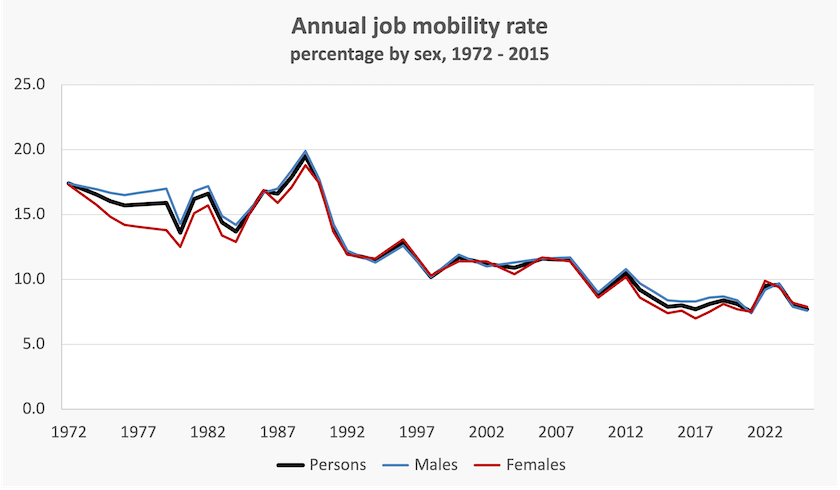
We are hanging on to our jobs longer than we used to. It’s hard to interpret just what this means: it may be that we find our jobs more satisfying, or it may mean that we feel less secure, less willing to take a risk by shifting to a new employer, or to a new occupation.
On Radio National Breakfast Peter Martin suggests some of the reasons for this trend, and for our general low mobility, which is lower than in many similar countries.[1] It is possible that because over the long term wages and salaries have risen, we are more content in our jobs. This is consistent with the observation that more Australians are in professional and technical occupations, where skills accumulate with experience, and people therefore can do well by staying with the same employer or in the same occupation.
Also explaining our comparatively low mobility Martin points to the high transaction costs in moving house. Changing employment often means changing location, and our practice of charging high stamp duties on real estate (rather than collecting revenue through higher local government rates) discourages physical mobility. Many attempts to get state governments to reform this brake on mobility have failed.
Maybe fifty years ago, when fewer women were in the workforce, the decision to move location involved only one person: when there are two people in meaningful employment moving is more difficult. And there is always the problem of disrupting children’s education.
Martin also notes the presence of non-compete clauses that restrict people from working for competitors when they lose a job, such clauses having become much more commonplace in Australia. These act as a dampener on productivity and higher wages. The Commonwealth plans to ban such clauses for employees with incomes below a certain level – probably $175 000.
Another possibility is that people simply feel less financially secure than they did 50 years ago. That doesn’t mean they are worse off – wages and other benefits have improved tremendously. But people have fewer buffers. Household savings ratios are low. People are taking out longer-term mortgages. Many people use car loans to buy cars. We seem to have less free-cash flow in relation to our life styles than we did fifty years ago. It’s as if capitalism has learned that the best way to keep a workforce compliant is to make sure people are in debt up to the hilt paying for stuff that they don’t need.
Employers may like the idea of a workforce tied to their existing companies. But what’s good for individual firms in not necessarily good for the economy. When someone shifts to a competing firm that uses labour more productively and is able to pay higher wages, the employee, the competing form, and the economy all benefit. That’s how wages and productivity improve.
In the same publication the ABS reports on the rate of retrenchments over the same period, shown in the graph below. We can see the consequences of the 1990 “recession we had to have”, the GFC, and the pandemic, but the trend is downward.
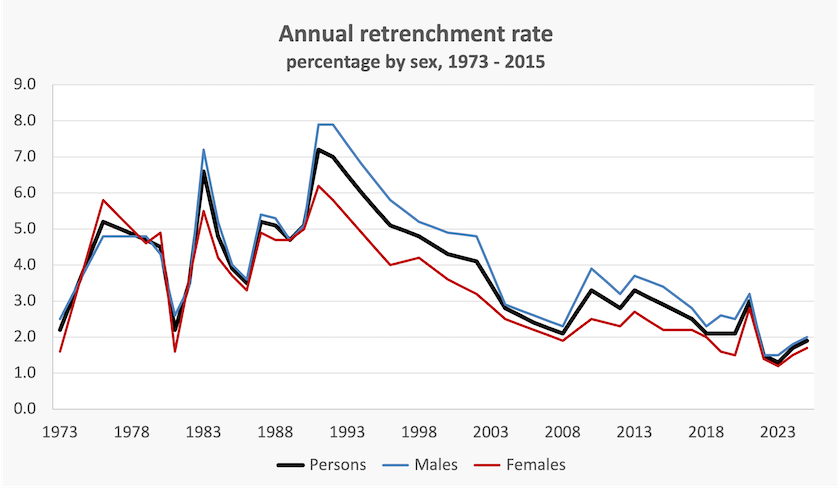
That’s not the impression we get from the media, where every closure or downsizing is presented as a national disaster, often presented as a catastrophe, but closure and renewal is an escapable aspect of capitalism.
It’s notable from this series that women seem to be more secure in their occupations than men, possibly reflecting the comparative employment stability in the female-dominated care industries.
1. Sorry, no hyperlink. Radio National puts links to its longer Breakfast segments, but not to Peter Martin’s short economic gems. To listen you either have to be tuned in from 530 am, or find it within the 3-hour program on the RN site. ↩