Public ideas
A western story
Economic and military hubris explains much about the decline of “the West”.
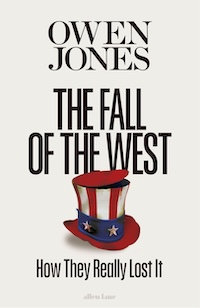
A common story, confirmed by the success of populist movements in “western” countries, is that the age of the political left is behind us. Social democratic parties lost their attraction to the population when they became preoccupied with “woke” issues, such as the rights of LGBTIQA people, and they lost connection with ordinary working people.
Guardian journalist Owen Jones challenges that model in his article The west is in freefall – and the worst part is that we were warned, but chose not to listen.
He acknowledges that the “West” (a loosely-defined term with little geographical or even cultural meaning) has been declining in economic performance and military capability, relative to the success of non-western countries.
But as he says, his diagnosis is rather different from the prevailing right-wing story:
The west is in decline because after the cold war, its elites declared a victory from which they have never recovered. They proclaimed an economic model that channelled wealth upwards as the inevitable future, while treating an apparently invincible military as free to reshape the Muslim world. Both convictions were terribly convenient for those who benefited from them. The result has been catastrophic: an economy that no longer delivers sustained improvements in living standards or public services, and western military interventions humiliated in Kabul, Baghdad, Tripoli and now the strait of Hormuz.
His most recent book, The fall of the west, was published this week.
Trust
Trust as an investment with dividends in productivity.
Those who have read the works of political philosophers such as Elinor Ostrom, Robert Axelrod and Russell Hardin will be aware of the importance of trust as a shared asset that contributes to human wellbeing.
Trust is the theme of Productivity Commission Chair Danielle Woods’ Centre for Public Integrity Oration: Growing trust and trusting growth: the economic case for integrity.
She draws on hard data and basic economic theory about transaction costs to demonstrate how trust works in an economy such as Australia’s to improve productivity, linking theories of political philosophy with one of our most pressing economic concerns. She draws our attention to the cost of corruption – not only the cases of brown paper bags stuffed with cash, but also the less obvious and technically legal forms of corruption, such as pork barrelling, projects that are allowed to bypass benefit-cost scrutiny and political patronage.
She goes on to remind us of the importance of trusted public institutions with some independence from executive government. Compared with other democracies Australia has a rich collection of such institutions.