Economics — monetary stuff
The Reserve Bank’s decision
Monetary policy is supposed to stabilize the economy, but the RBA’s swings in interest rates are destabilizing the economy because of its reliance on poorly-chosen indicators.
The only surprise in the Reserve Bank’s decision to lift the cash rate to 4.60 percent is that it was unanimous, suggesting that the whole board has been converted to the religious faith known as monetary policy and belief in the infallibility of the Phillips Curve.
The Bank’s statement tells a mixed story about the state of the economy, in part because not all economic indicators are pointing in the same direction, and no one has the first idea about Trump’s next moves and only a vague idea of where artificial intelligence is taking us. The most serious words are in its last paragraph:
The Board will continue to do what it considers necessary to bring inflation sustainably back to target, including increasing the cash rate target further if needed.
Is that bluff, or an unshakeable determination to let the CPI drive monetary policy, in spite of all its limitations and biases?
Gareth Hutchens has a post explaining the Bank’s decision, including a revealing history of the board’s voting record since March last year, when voting information was first made public. He also reports on the reactions of economists, who seem to accept that the bank is subject to the immutable rules of the dismal science.
Sarah Huangfu of the University of Sydney has a Conversation explanation of the Bank’s decision. She draws attention to signs that the economy is slowing rather quickly, pointing out the crude way monetary policy works in a complex economy.
Politically the arguments are around the drivers of inflation – external factors (particularly oil prices) or internal factors (public spending and low productivity). The partisan line is that government spending is running rampant, contributing to excess demand inflation.
It’s a hard line to hold when we have a fiscally conservative government running an effectively balanced budget. But you can hear Liberal treasury spokesperson Tim Wilson trying to argue this line on the ABC’s 730: he collapses into a babble of incoherence when Sarah Ferguson asks him to explain what aspects of the government’s spending a Coalition government would cut.
Michael Janda has a post, the title of which summarises its content: Australia's rising interest rates are not just down to government spending. He does not entirely dismiss the possible contribution of government spending to inflation, but he is critical of the Coalition’s call to cut spending:
If the government's deficit is part of the problem, Angus Taylor's solution of "axing Labor's toxic taxes" in the absence of concrete plans to slash government services or payments to make up for the lost revenue, and then some, is hardly a fiscally responsible alternative.
He is even more critical of the way the burden of higher interest rates falls disproportionately on mortgage holders. Clarifying the gobbledygook in the Bank’s press release, he writes:
In plain English, we need you, mortgage borrowers, to enjoy a lower standard of living so that the economy has capacity to build lots of data centres and pay for more expensive fuel imports while inflation still comes down.
That’s quite at variance with the RBA Governor’s sweeping and rarely-challenged statement “high inflation hurts allAustralians”.
When we look at the recent history of official interest rates, shown in the chart below, we can understand Janda’s argument. Note that huge 7 percent change: was monetary policy ever meant to operate over so wide a band?
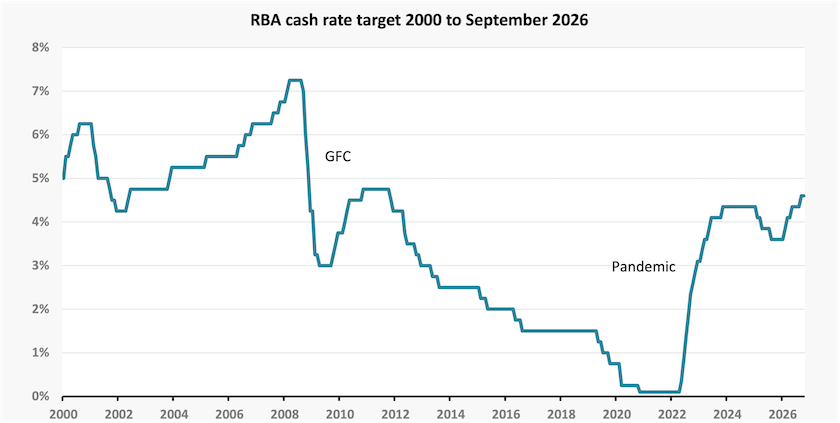
In the years after the global financial crisis, the Reserve Bank kept dropping interest rates, trying to stimulate an economy beset by poor productivity. Extraordinarily low interest rates in the pre-pandemic period led many people into becoming over-burdened with mortgage debt. This growth in debt was aggravated by house price inflation. It was a textbook inflationary case of too much money chasing limited resources, but the Bank wasn’t concerned, because, as a result of an arbitrary technocratic decision, housing prices (apart from construction costs) are not included in their Bank’s inflationary indicator, the CPI.
The irony is that monetary policy, which is supposed to be one of the two main stabilisers of the economy, has become a destabilising instrument. We have developed formulas that lead to dysfunctional monetary management.
Crispin Hull explains how raising interest rates can contribute to inflation.
The tragedy is that offering sacrifices to the low-inflation dragon might be as ineffectual as Aztecs butchering people atop pyramids in the hope of delivering rain. The theory is that if you take money out of disposable incomes, people will spend less so businesses will have to refrain from increasing prices if they want to keep attracting sales. But businesses have to make a profit. If the cost of their inputs goes up, they have to pass some or all of that on to customers to stay profitable.
Alan Kohler in an ABC News podcast – how AI's moving interest rates – describes the possible path of CPI inflation and therefore interest rates in the next year or so. It’s a 15-minute lay person’s explanation of macroeconomic policy.
In that context he considers the possible effects of artificial intelligence on our monetary settings. There is no doubt that construction of data centres has put high demand on certain resources, as the RBA acknowledges. But there is also the possibility that AI will have such a strong influence on productivity that we could see the economy in a deflationary situation, with rising unemployment, particularly in view of the way AI operates so quickly to displace human workers.
That means the RBA may find itself reducing interest rates in the not-too distant future. There is also the possibility that grownups take control of the politics of the Middle East, allowing oil to flow, similarly contributing to disinflation (what goes up sometimes comes down). That points to the risk of more instability in interest rates, as the Bank’s board goes on overinterpreting and over-reacting to economic indicators, particularly the CPI.
Janda has some suggestions about how monetary policy can be reformed: a serious public debate about monetary policy would be far more productive than Wilson’s and Taylor’s childish attempts to allocate blame to our conservative government.
The CPI
The August CPI shows the effect of higher fuel prices, and early signs of falling electricity prices.
The CPI came in at 3.9 percent over the twelve months to August, which monetary hawks will take as a vindication of the Reserve Bank’s decision to lift interest rates. The trimmed mean, of 3.6 percent, is a little lower.
Because headline reporting is about the CPI’s twelve-month movement, we should not be surprised by this comparatively high figure, because it comes off a low base in August 2025. shown in the graph below (green line). The ABS is developing a seasonally-adjusted series for its monthly figures, which means in time a chart of index numbers will become smoother, but for now all we have is the raw data.
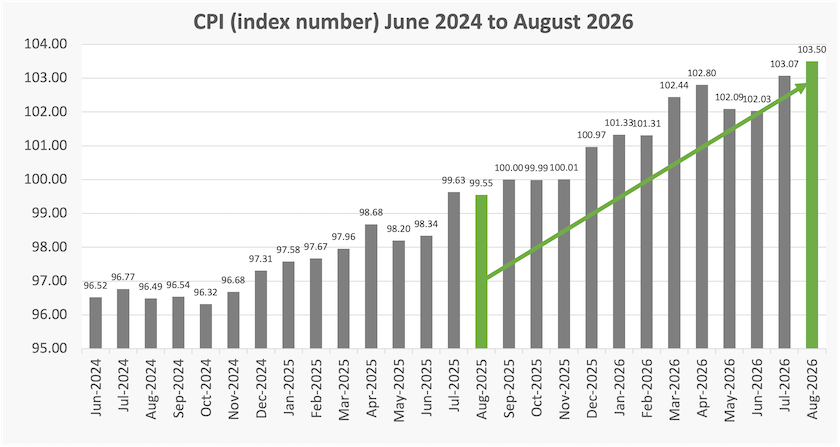
There has been a significant movement in the CPI since June. In those two months the transport group has risen by 7 percent and within that group automotive fuel sub-group has risen by 15 percent.
The electricity sub-group, by contrast, has fallen by 2 percent since June, but most journalists haven’t noticed this because they are looking at twelve-month data, which includes the effect of withdrawal of subsidies.
This 3.9 percent rise is a little lower than people in the financial markets had expected: they were forecasting a 4.0 or 4.1 perceen rise. As a result they significantly changed their expectations that the Reserve Bank will raise interest rates when it meets in November: on Tuesday a rise was a near certainty; on Wednesday it was a very low probability.
In view of the importance of inflationary expectations, it is surely worrying that such a small change – a change that can result from rounding, from the precise timing in certain price changes, from minor mistakes in the ABS – can have such consequences. This does not instill confidence in the way interest rates are determined in Australia.
Note that the next CPI will be off a higher base, the September 2025 base, which could mean a lower yearly figure is recorded.