Economics — fiscal stuff
Jim Chalmers’ magic $6 billion
The Commonwealth is running a balanced budget. Those who accuse it of over-taxing and over-spending should come clean with the electorate about where they would cut spending.
There was much excitement about the final fiscal outcome for 2025-26, which found the Commonwealth’s cash deficit was $22.3 billion, rather than the $28.3 billion forecast in the budget. The Treasurer and a chorus of his ministerial backers proclaimed “The bottom line is better than what we inherited, better than what was forecast at the election and it’s improved again since the Budget”.
It means that the fiscal deficit, originally forecast to come in at 1.0 percent of GDP, was actually 0.8 percent of GDP. On those figures most people, other than those with a partisan axe to grind, would say that the Albanese government is running a balanced budget. In terms of economic consequences the 0.2 percent difference is trivial, but such is the torrent of lies and misinformation directed against the government by the troika of right-wing parties and their media colleagues, that the government has to use every opportunity to remind the electorate of its conservative fiscal management.
Chalmers is right when he asserts that “we have one of the strongest budgets in the G20 and much lower gross debt than every major advanced economy”. By way of comparison the USA has a fiscal deficit of 6.5 percent of GDP, the UK 5.2 percent, and Germany 4.2 percent.
And the government is chipping away at the debt it inherited from the Morrison government, which the Liberal Party falsely calls “Labor’s debt” on a scary website. In fact the government’s small budget deficit is about the same as the interest on that debt, which means receipts and outlays as incurred by this government are close to exactly balanced.
Unsurprisingly, in response to the published fiscal outcome, the Liberal Party pulled together a few numbers out of context (for example quoting gross debt rather than net debt) in a press release: Chalmers squanders higher taxes with reckless spending, debt soars fuelling inflation & interest rate hikes.
Debt isn’t “soaring”: gross debt and net debt, as percentages of GDP, are actually falling.
But the most telling aspect of the Liberal Party’s statement is its reference to “reckless spending”. Angus Taylor has an opinion piece in the Financial Review If Labor spent less, rates could be seven cuts lower, blaming the government for the rise in interest rates since 2022, because that “reckless spending” has put demand pressure on the economy, causing the CPI to rise, requiring the Reserve Bank to raise interest rates.
That’s rubbish. The government has run a conservative fiscal policy from the day it was elected. The pressures on prices are largely external, particularly from world oil prices driven by Trump’s and Putin’s military misadventures, and Trump’s inflationary policies in the US. But Taylor is reluctant to criticize his ideological colleague in the White House. There are also some domestic price changes resulting from poor agricultural conditions and more-toughly enforced standards on temporary migrants’ pay and conditions, but these have nothing to do with excess government spending.
Taylor’s main point about “reckless spending” concerns the lift in the Commonwealth’s outlays, shown in the graph below, which, in round terms, have risen from 25 percent of GDP before the Covid shock to 27 percent of GDP.
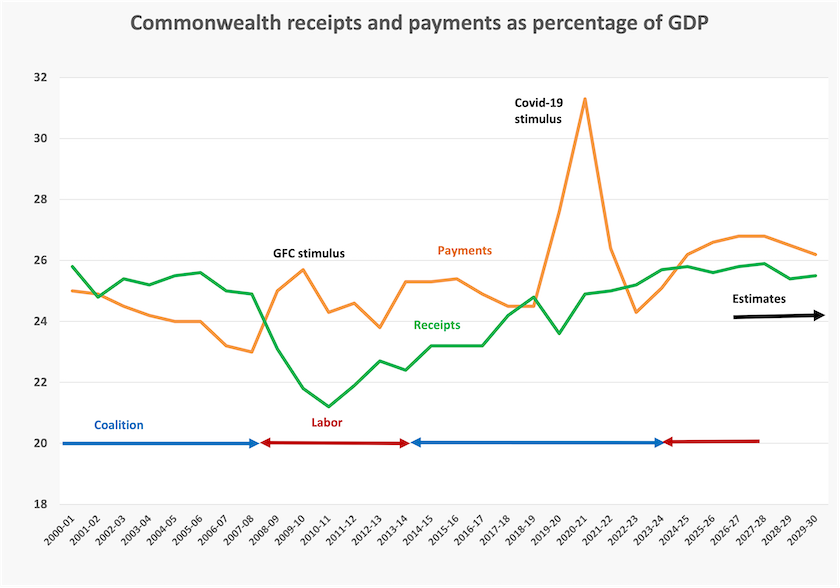
Taylor says that the government, instead of spending that money on government services, should have accumulated a $22 billion surplus.
It’s a re-framing of his often-aired argument that the economic recovery from the Covid shock wasn’t real growth. That’s because it was based on government spending – spending that propped up the recorded GDP but which brought no benefit to the Australian people, because he assumes that only the private sector is the creator of real wealth and employment.
Let’s stop to think about that. The government points out that much of that boost in spending has gone into the care economy, including health, aged care, child care. Is that not useful economic activity?
The brutal logic of Taylor’s ideology means that we enjoy more benefit from spending on sports betting than we do if the same is spent on a nurse in a public hospital, because the former is in the private sector while the latter is in the public sector. Spending on smash repairs is good economic activity because it’s in the private sector, but public spending on safer roads is “reckless government spending”.
If people are doing things for one another, whether funded by market transactions, charitable donations, taxes or barter, that’s economic activity. The substance of the activity is more important than its funding source.
That simple logic needs greater exposure, because the public seem not to have understood the consequences of the perverted One Nation – National Party – Liberal “small government” ideology. Many people are enticed to the attitude that taxes are money the big beast of the government takes from you, rather than payment for public goods.
In this regard it’s a poor service to the public when journalists, including journalists employed by our public broadcaster, allow politicians to say they will cut spending without being asked a simple question “and where do you believe those cuts should be made?”. Coalition politicians hardly miss a chance on air to say something about “Labor’s reckless spending” and they get away with it. Letting such statements pass unchallenged surely reveals partisan bias.
Opposition parties are appealing to voters who are dissatisfied with their governments. In outer suburbs neither the roads nor public transport are adequate; promised schools and hospitals are delayed; there are never enough police to deal with domestic violence and youth crime. In non-metropolitan Australia the roads are potholed and government services are being withdrawn or concentrated in population centres. Governments make many announcements and they commission studies, but nothing material happens. Waiting times for government services – surgery, visas for employees, approvals for buildings – take far too long. Social security support including Newstart and NDIS are too stingy. Universities and public schools are underfunded. And that’s before we get on to the demands of the defence establishment.
That’s an assembly of grizzles as reported in the media – a dismal and exaggerated picture – but it is clear that people want governments to do more, not less.
So what’s the response of politicians on the right, and of media in the right-wing echo chamber?
It’s to lambast the government for spending too much, and promise that taxes will be cut if their mob can throw this irresponsible high-spending government out of office.
We shouldn’t be surprised that there are strong voices, including in the partisan media, urging people to vote against their own interests. That’s been the long-standing political model of populist politics.
It fits with a simple narrative: “this mob has failed, the others must be better”, where the “others” include insurgent movements backed by big money – Trump’s MAGA, Farage’s Reform, Hanson’s One Nation.
It fits with people’s impatience – a failure to understand how long it takes to achieve economic reform. Taylor says that the government has had “more than four years to shape the Australian economy”. That’s a valid observation: the Albanese government has been slow to implement reform, but it inherited a structurally weakened economy suffering from decades of indolent economic management, mainly on the Coalition’s watch. Every small step of economic reform has been met with tantrums of protest from those upon whom the Howard government showered unearned economic privilege.
By now we have had ten years since Trump’s first election and Britain’s exit from the EU, to study and understand those who are attracted to far-right populist movements. They’re the working class, as broadly defined to include small farmers, and people running very small businesses. They even include people who were more comfortable in the communist regime of East Germany than in the competitive and globalised world of a unified Germany.
These are the people who once formed the base of social-democratic parties. The challenge for Labor is to win them back.
Getting serious about tax
Contrary to manipulated public opinion, Australia is a low-tax country. We need to be realistic about the need to raise taxes.
How we compare
Some say that Australia tries to sustain a European standard of government-financed services while collecting American level taxes.
There is some truth to this assertion. As has occasionally been pointed out in these roundups, in comparison with other high-income OECD countries, our taxes are among the lowest. The graph below shows taxes, at all levels of government, as a percentage of GDP for the 15 highest-income OECD countries. We’re down on the low-tax end.
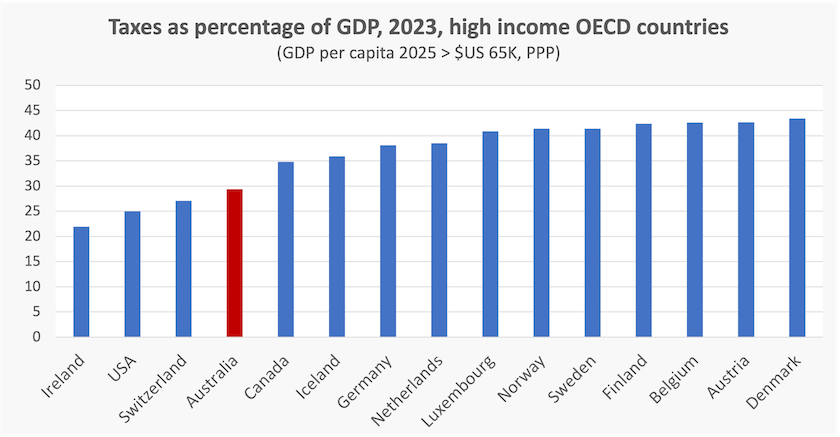
To the left of us on the graph are Switzerland and Ireland, both tax havens, and the USA, who for now can get away with a fiscal deficit of 6.5 percent and rising. If ever the world stopped lending to the US and stopped using its currency for international transactions the USA would have to raise taxes by at least 5 percent of GDP if it were to run the same level of deficits as more conservatively-managed countries such as Australia. In other words our sustainable level of taxation is lower than America’s.
We’re trying to cope with low taxes
The present government is trying to muddle through with low taxes, keeping Commonwealth taxes at around 26 percent of GDP, and restraining spending to around 27 percent of GDP, with a 1 percent deficit. The Intergenerational Report(IGR) projects that Commonwealth spending will rise another one percent of GDP, from 26.6 percent of GDP at present to 27.7 percent of GDP by 2065-66 and that there will be an ongoing deficit of about 1 percent in the short term and up to 2 percent of GDP in the long term. Scaremongers may say that ongoing deficits are irresponsible and unsustainable, but just as a successful company can increase its debt over the long run, so can a country.
In fact the IGR projections imply a surprisingly modest growth in public expenditure. An ageing population, the intrinsic labour intensity of government-funded human services, and projected increases in defence spending, all make for more pressure on government outlays, but the IGR projects that spending on public pensions will fall as people’s retirement is increasingly funded by superannuation, offsetting areas of spending growth.
It is possible, however, that the IGR understates the need for public spending, particularly in relation to dealing with the effects of climate change. We may have to spend much more on relocating populations and investing in entirely new infrastructure, than is included in the modest spending on disasters and remediation assumed in the report. There is a note of scepticism about the IGR’s projections on the cost of adapting to climate change in Peter Martin’s summary of the IGR in the Saturday Paper: The big flaw in Australia’s intergenerational growth story. The risks of rising sea levels, higher temperatures, lower crop yields and the degradation of Australia’s tourist attractions are not independent: they are interlinked which means that the probability of all four occurring at once is not much lower than any one of them occurring.
It is also notable that the fiscal aspects of the IGR concern only Commonwealth funding. In view of states’ and local governments’ responsibility for schools, policing and hospitals, and their limited capacity to raise taxes, it is inevitable that there will be increased demand for Commonwealth assistance to state and local governments.
All this means that unless the standard of public services is to fall, there is no prospect of public spending falling in the next 40 years. That is, unless there is some extraordinarily disruptive cut in public services involving complete withdrawal of some services and the privatization of others. But there is no political appetite for such a transition: the public have learned that privatization generally involves replacing low-cost public services with a higher-cost and generally lower-standard private service, particularly in human services.
Where are the voices for higher taxes?
But so far, apart from the Australia Institute’s campaign on gas taxes, there are few serious voices calling Australia to bring its taxes up to the level paid in other “developed” countries.
One possible explanation for this is the relentless “small government” propaganda from the right. Almost half the population believe that Australia is a “high-tax-big-government” country, according to the regular Per Capita tax surveys.
Another reason for such a belief may be our comparatively high reliance on income taxes. The graph below shows the composition of taxes in those same 15 high-income countries, and Australia is only behind the USA and Belgium in its reliance on income taxes as part of its tax mix. In part that is a mathematical artefact because, like the USA, our overall tax base is so low but even so, we are heavily reliant on personal income taxes.
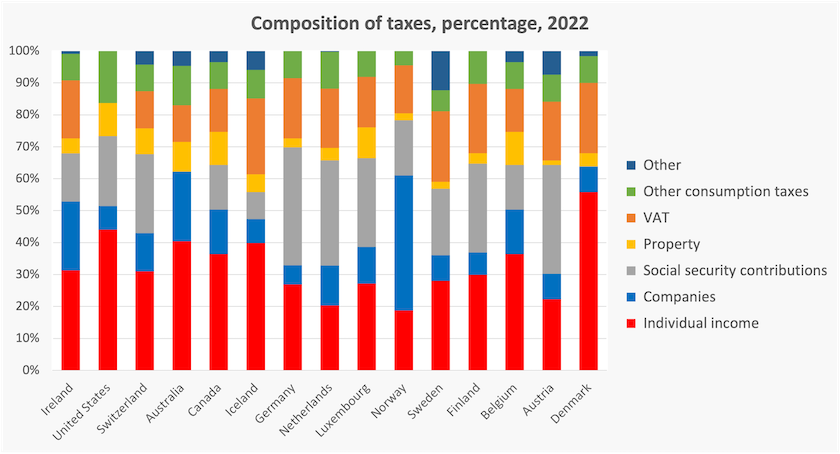
Income taxes are among the most visible of all taxes, because they appear as deductions in people’s pay packets. Every nominal pay rise is dampened by withdrawal of income tax at the marginal (not the average) tax rate.
There are good reasons for holding back on any increase in income taxes. But there is a strong case for making sure that income taxes are paid by closing channels of evasion and avoidance. The government has made some baby steps in this direction in relationship to family trusts and income from real-estate speculation, but there is much further to go, particularly relating to so-called “self-funded” retirees who can enjoy incomes up to $170 000 without paying a cent of tax.[1]
Notably our value-added-taxes (GST in our case) are low in comparison with other countries. These are the most unavoidable of all taxes. Some on the left point out that value-added-taxes are regressive. That’s correct, but if they are directed to public services – state government services in Australia’s case – the net equity effect is generally progressive.
There is a strong case for specific carbon taxes rather than the present ad-hoc set of tax-like incentives and disincentives associated with our energy transition. In this regard the transport sector is severely undertaxed, because fuel excise is enough to cover only part of the cost of road funding, which means there is no environmental tax on gasoline and diesel.
And there remains a strong case for wealth taxes, including inheritance taxes. Local and state governments already collect wealth taxes based on land values. There is a case for the Commonwealth to extend wealth taxes to financial assets.
1. Does that seem to be unbelievably high? It’s based on a 5 percent return on $3 million of assets in superannuation, and another $18 000 in non-superannuation assets held personally. $150 000 + $18 000 = $168 000. Double for a couple. ↩